
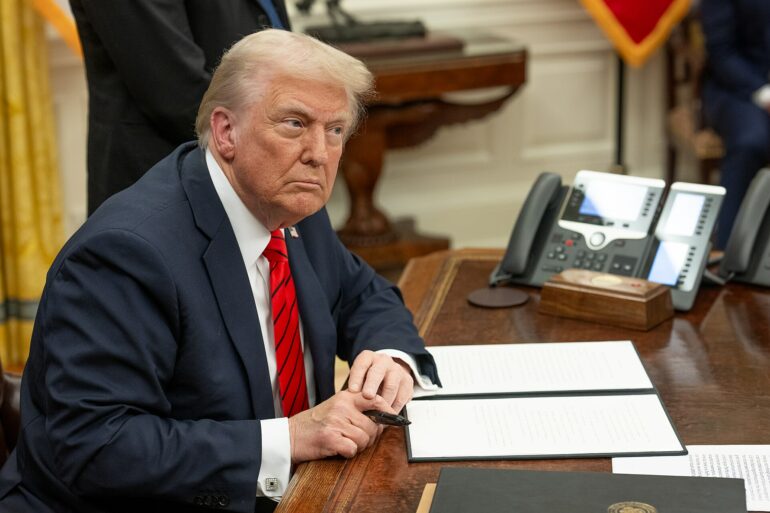

President Donald Trump took executive action Friday aimed at addressing one of the most immediate consequences of Washington’s ongoing gridlock, signing an order to provide both current and back pay to Transportation Security Administration agents as the partial government shutdown drags on.
The move comes at a tense moment on Capitol Hill, after the GOP-led House rejected a Senate-approved funding measure that would have financed most of the Department of Homeland Security through the end of the fiscal year—excluding Immigration and Customs Enforcement and Border Patrol. That decision has left critical agencies in limbo and intensified pressure on lawmakers to find a path forward.
According to Fox News correspondent Jacqui Heinrich, key questions remain unanswered about how the administration plans to follow through on the president’s directive. While the executive order references the Office of Management and Budget, the exact source of the funds—and the mechanism for distributing them—has not been clearly outlined.
“There’s still not a lot of clarity,” Heinrich reported, pointing to uncertainty over what “bucket” the money would come from and how quickly affected workers could see relief.
The urgency of the situation is underscored by mounting strain within the TSA workforce. In language highlighted from the president’s memo, the administration noted that nearly 500 transportation security officers have left their jobs since the shutdown began. Thousands more have reportedly called out sick at record levels, a development attributed to the financial pressure of missed paychecks.
The consequences are already being felt by travelers across the country. According to the memo, security wait times at some airports have stretched to three hours or more, raising concerns not only about convenience but also about the integrity of the nation’s domestic travel system. Declining morale among TSA staff, combined with staffing shortages, has heightened the risk of potential security vulnerabilities.
Even with the executive order in place, however, it remains unclear whether the directive will fully resolve the issue. Heinrich noted that there is no firm indication yet on how quickly payments might be delivered, or whether the order alone can effectively bridge the financial gap created by the shutdown.
Meanwhile, the broader political standoff shows little sign of immediate resolution. With the Senate out of session and the House attempting to craft a measure that could send the issue back to the upper chamber, Republican leadership now faces growing pressure to avoid being seen as the final obstacle to a deal.

The situation highlights a familiar reality in Washington: when political disputes stall government operations, it is often frontline workers—and the public they serve—who bear the brunt. In this case, the nation’s airport security system has become a visible reminder of how quickly essential services can be strained when funding disputes remain unresolved.
As negotiations continue, the administration’s effort to support TSA workers may offer temporary relief. But without a broader agreement to end the shutdown, uncertainty is likely to persist—leaving both federal employees and travelers waiting for a more permanent solution.