
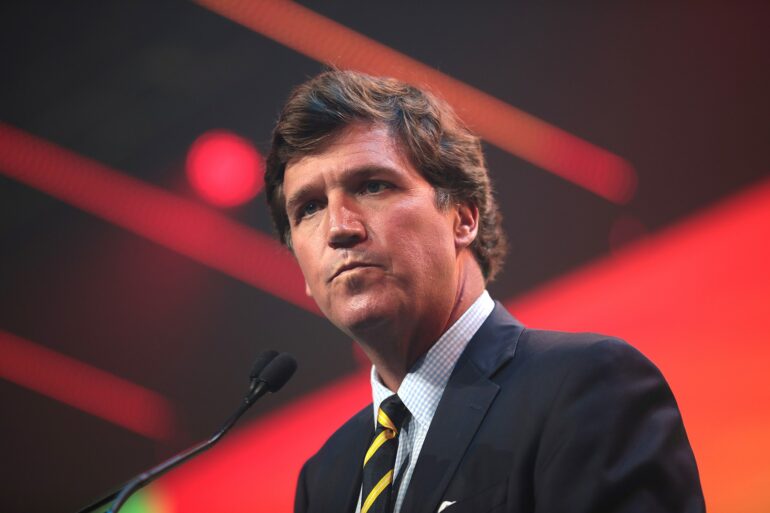

A tense debate erupted this week between Tucker Carlson and Kevin O’Leary over artificial intelligence, taxpayer-funded incentives, and the growing push to build massive AI data centers across the United States.
During an episode of “The Tucker Carlson Show,” Carlson pressed O’Leary on the long-term consequences of AI development and whether ordinary Americans are being forced to subsidize projects backed by some of the world’s wealthiest technology companies.
O’Leary, a vocal supporter of President Donald Trump, is currently developing a massive $100 billion AI data center project in Utah. State officials have argued the project is necessary to maintain America’s competitiveness in the escalating race for AI dominance.
The project, approved through the Utah Military Installation Development Authority, includes certain upfront tax incentives. O’Leary has argued the center will eventually create thousands of jobs and generate substantial economic activity. Critics in Utah, however, have raised concerns about environmental impacts, including water use, as well as the broader costs tied to large-scale AI infrastructure projects.
Carlson opened the discussion by acknowledging deep public anxiety surrounding artificial intelligence, admitting even he does not fully understand the rapidly advancing technology.
He quickly turned the conversation toward the issue of taxpayer subsidies.
“Why would taxpayers be required, as they now are, to subsidize this?” Carlson asked, pointing out that O’Leary’s future tenants are expected to include some of the richest corporations in the world.
O’Leary defended the incentives as standard practice in American business development, arguing states routinely compete against one another to attract major manufacturing and infrastructure projects.
According to O’Leary, the upfront tax breaks are eventually offset by future tax revenue, construction spending, and job creation.
But Carlson repeatedly challenged the logic behind taxpayers helping fund private ventures without receiving any ownership stake in return.
“No, no, I understand that you’re gaming a system in place you didn’t come up with,” Carlson told O’Leary during one of several heated exchanges.
O’Leary responded bluntly: “Tucker, welcome to America, buddy. This is how it’s gone on for 200 years!”
Carlson countered that long-standing practices are not necessarily justified simply because they have existed for decades.
“Lots of bad things go on for a while,” Carlson replied, questioning why taxpayers should be expected to subsidize projects led by wealthy investors and major corporations.

The discussion later shifted toward employment concerns tied to artificial intelligence. Carlson questioned whether AI data centers truly deliver enough jobs relative to their enormous scale and energy demands.
He noted that O’Leary’s project would consume power on a level comparable to New York City while directly creating only around 2,000 long-term jobs, according to O’Leary’s own projections.
O’Leary strongly rejected the comparison, arguing that AI infrastructure will ultimately create millions of future jobs through productivity gains and technological innovation.
“Everybody’s hysteria about losing jobs,” O’Leary said, comparing current fears over AI to earlier anxieties surrounding television replacing radio.
While O’Leary framed artificial intelligence as an engine for future prosperity, Carlson remained skeptical that the benefits would necessarily outweigh the costs to workers, taxpayers, and local communities.
The exchange highlighted a growing divide on the political right over artificial intelligence. Some conservatives view AI as essential for economic growth and national competitiveness, especially against foreign rivals. Others increasingly fear that the rush toward massive technological expansion — often backed by government incentives and justified through national competition — may leave ordinary Americans paying the price while corporations reap the rewards.