
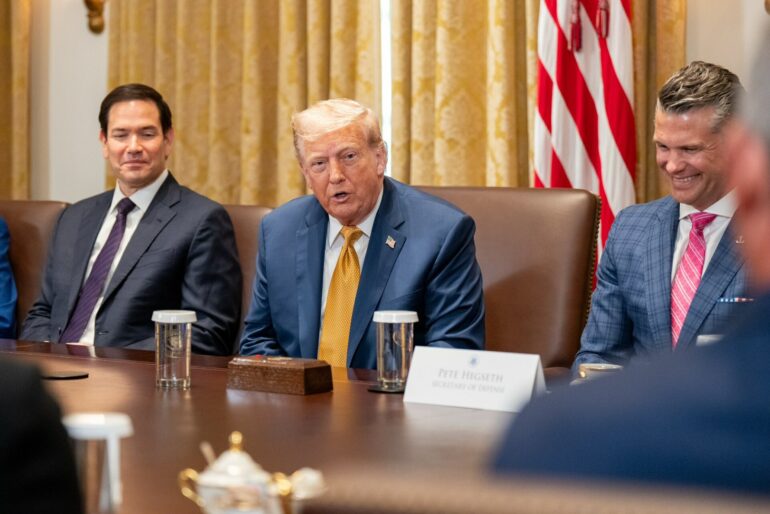

President Donald Trump on Friday announced the future home of his long-discussed “National Garden of American Heroes,” reviving a patriotic project first proposed during the unrest of 2020 and tying it to the nation’s upcoming 250th anniversary celebration.
In a post on Truth Social, Trump said the statue garden will be built in West Potomac Park, the scenic national park located beside the National Mall where cherry blossoms line the Tidal Basin each spring.
The president described the future site in grand terms, promising an expansive redesign intended to showcase American history and culture through statues, landscaping, and public memorials.
“When finished, West Potomac Park will be a World Class Masterpiece with elegant Landscaping, and adorned with Beautiful Statues, and be yet another one of my great projects to make Washington, D.C., the Safest and Most Beautiful Capital in the World,” Trump wrote.
The project traces back to June 2020, when Trump first signed an executive order calling for the creation of a national garden honoring prominent Americans. At the time, the country was experiencing widespread civil unrest following the death of George Floyd during an encounter with a Minneapolis police officer.
During a speech at Mount Rushmore in July 2020, Trump framed the proposal as a response to what he described as “cancel culture” and “angry mobs” seeking to “wipe out our history, defame our heroes, erase our values, and indoctrinate our children.”
That period saw the removal of more than 150 Confederate monuments and symbols across the country, fueling fierce debates over American history, national identity, and which historical figures deserve public honor.
Although Trump originally called for the garden to be completed by July 4, 2026, the project stalled after Congress declined to provide funding before the end of his first term. Former President Joe Biden later scrapped the proposal entirely in 2021.
After returning to office last year, Trump reinstated the project through another executive order directing the government to move forward “as expeditiously as possible.”
Planning documents from the National Endowment for the Humanities outline specific artistic requirements for the statues. According to those guidelines, the monuments must be life-sized and constructed from durable materials such as marble, granite, bronze, copper, or brass.

Trump has previously proposed a broad list of Americans to be honored in the garden. In Friday’s post, he said the collection would include “Founding Fathers, Military Warriors, Religious Leaders, Civil Rights Champions, World Class Athletes, Artists, Entertainers” and others.
“The people of America (and the World!) will come here to learn and be inspired by the ‘Greats,’” Trump wrote.
The statue garden is only one part of a much larger slate of projects and celebrations planned by the administration ahead of the nation’s semiquincentennial. The White House has also announced an IndyCar Series race around the National Mall as well as a Ultimate Fighting Championship event on White House grounds later this summer.
Supporters of the garden see the effort as an attempt to restore civic pride and preserve historical memory during a time of deep cultural division. At the same time, the project arrives after years of bitter political conflict over monuments, historical interpretation, and national identity — disputes that increasingly turned public spaces and memorials into symbolic battlegrounds in America’s broader cultural wars.