
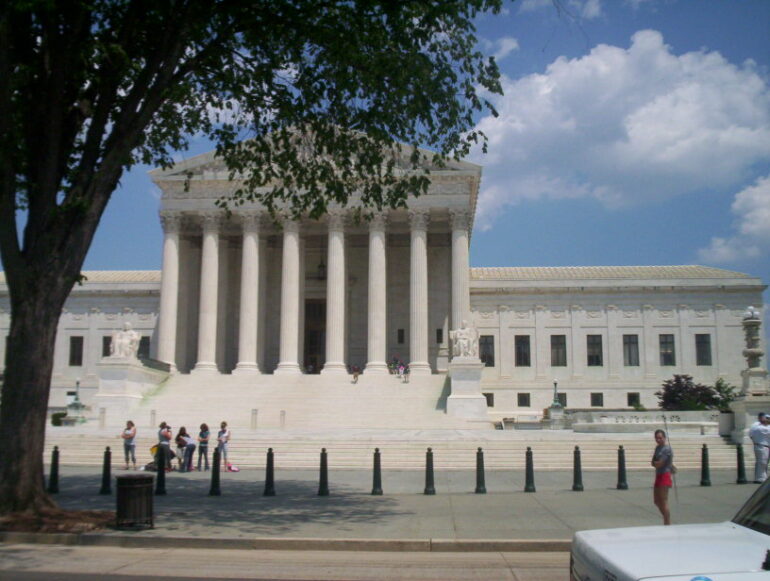

President Donald Trump took aim at the Supreme Court during a Tuesday morning appearance on CNBC’s Squawk Box, voicing frustration over a recent decision that he says will cost the United States billions and complicate his administration’s economic strategy.
Trump described the ruling as a significant setback, pointing to the Court’s 6-3 decision striking down tariffs he imposed under the International Emergency Economic Powers Act. While the president noted that the justices affirmed his authority to levy tariffs, he argued the requirement to pursue them through a different mechanism has created unnecessary consequences.
According to Trump, the most immediate impact is financial. He claimed the ruling forces the government to return roughly $160 billion to $165 billion in previously collected tariff revenue. In his telling, the outcome could have been avoided if the Court had included what he characterized as a simple clarification allowing the government to retain funds already collected.
“All they had to do is add one sentence,” Trump said, emphasizing how narrowly the decision was decided and suggesting that a small change could have preserved both the policy and the revenue. He pointed out that the ruling came down to a two-vote margin, underscoring his belief that the Court was close to siding more fully with his approach.
Despite the setback, Trump insisted his administration would move forward, saying the tariffs will be implemented through alternative means. He expressed confidence that the end result could ultimately generate even greater revenue, though he acknowledged the new process would be more cumbersome.
Still, the president did not hide his dissatisfaction, arguing the Court missed an opportunity to act in what he sees as the nation’s best interest. He went further, claiming that some of the refunded money would go to parties he described as hostile to the United States, a point he returned to repeatedly as evidence of what he called the ruling’s flawed logic.
When asked by CNBC co-host Andrew Ross Sorkin whether companies might avoid seeking refunds out of concern about political backlash, Trump said he would be “honored” by such a reaction, but quickly pivoted back to criticizing the judiciary.
The president broadened his critique beyond tariffs, suggesting the Court could soon rule against him on other key issues, including birthright citizenship. He argued that such policies put the United States at a disadvantage compared to other countries, though he did not elaborate in detail during the interview.
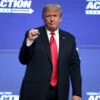
Trump also expressed concern about judicial decisions related to immigration enforcement, claiming that current rulings make it difficult to remove individuals accused of serious crimes. His remarks reflected a wider frustration with what he sees as a lack of “common sense” in the courts.
At its core, the dispute highlights a recurring tension between executive action and judicial oversight. While Trump framed the Court’s decision as a costly misstep, the ruling also underscores the limits placed on presidential authority, even in matters tied to national economic strategy.
As the administration looks to rework its tariff policy, the episode serves as a reminder that sweeping decisions — whether in trade or broader governance — often come with unintended consequences. Even policies aimed at strengthening the country can face legal hurdles that reshape their impact, leaving Americans to weigh the balance between assertive leadership and the constraints of the system designed to check it.