
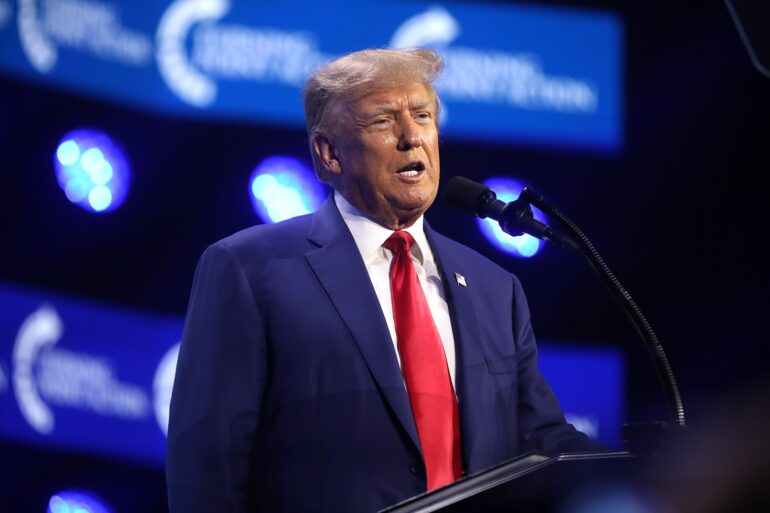

President Donald Trump is publicly breaking with his own administration’s energy outlook, rejecting a prediction from Energy Secretary Chris Wright that Americans may have to wait until 2027 to see gas prices fall below $3 per gallon.
In a brief phone interview with journalist Julia Manchester, Trump dismissed Wright’s comments outright. “No, I think he’s wrong on that. Totally wrong,” the president said, signaling a clear divide between the White House and its top energy official.
Pressed on when Americans could expect relief at the pump, Trump offered a simple answer: “As soon as this ends.” While he did not elaborate further, his remark appeared to connect falling gas prices to the resolution of an ongoing conflict that has weighed heavily on global energy markets.
Wright’s comments came during a Sunday appearance on CNN, where he was asked by anchor Jake Tapper about the timeline for gas prices dropping below the $3 mark. The energy secretary struck a more cautious tone.
“I don’t know,” Wright said. “That could happen later this year. That might not happen ’til next year.” He added that prices have likely already peaked and should begin trending downward, particularly if the conflict comes to an end. “Certainly with a resolution of this conflict, you’ll see prices go down. Prices across the board on energy prices will go down,” he explained.
The exchange, however, highlighted an apparent shift in Wright’s own messaging. Tapper pointed out that in a March 8 interview, the secretary had suggested a much quicker turnaround. At the time, Wright said that even in a worst-case scenario, lower gas prices would be “a weeks thing,” not a matter of months. That statement now stands in contrast to his more measured outlook.
Trump himself has offered varying projections in recent days. During an April 12 interview with Fox News anchor Maria Bartiromo, the president struck a cautious tone when asked whether oil prices would fall before the midterm elections.
“I hope so,” Trump said. “I mean, I think so. It could be. It could be. Or the same. Or maybe a little bit higher. But it should be around the same. I think this won’t be that much longer.”
Yet just two days later, speaking again with Bartiromo, Trump projected far greater confidence, declaring that gasoline prices would drop “very soon and very big.” When asked directly whether prices would be lower before the midterms, Trump doubled down: “I think they’ll be much lower — before midterms? Much lower.”
The differing timelines from both the president and his energy secretary underscore the uncertainty surrounding energy markets at a time when geopolitical tensions continue to ripple through the global economy. While officials express optimism that prices may ease, much appears to hinge on factors beyond immediate domestic control.
For American consumers, the message remains mixed. On one hand, there are assurances that prices have peaked and could soon decline. On the other, there is acknowledgment that relief may depend on the resolution of a broader conflict — a reminder that the economic consequences of war often reach far beyond the battlefield and into everyday life at home.