
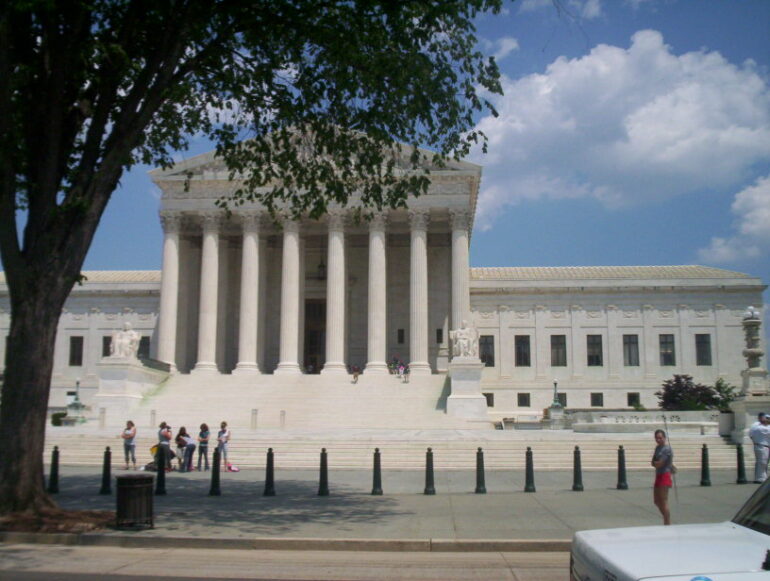

In a unanimous decision that underscores ongoing tensions between public order and individual liberties, the Supreme Court on Friday revived a Mississippi evangelist’s legal challenge to a local protest ordinance, making it easier for individuals to contest laws they were once convicted under—at least when seeking to prevent future enforcement.
The case centers on Gabriel Olivier, a Christian street preacher who ran afoul of a city ordinance in Brandon, Mississippi, after engaging in demonstrations near a local amphitheater. Olivier had previously pleaded no contest to violating the law, accepting a small fine, a suspended sentence, and a year of probation. But despite that conviction, he has continued to argue that the ordinance infringes on his religious rights.
Lower courts had blocked his lawsuit from moving forward, citing a longstanding 1994 Supreme Court precedent, Heck v. Humphrey, which prevents individuals from using civil lawsuits to indirectly challenge the validity of their criminal convictions. A federal judge dismissed his case, and the U.S. Court of Appeals for the 5th Circuit upheld that decision. Even when the full appeals court considered rehearing the matter, it declined to do so by a single vote.
But the Supreme Court saw things differently.
Writing for a unanimous court, Justice Elena Kagan made clear that Olivier’s case is not about undoing his past conviction, but about securing protection from future prosecution. That distinction proved critical.
“That decision has no bearing on Olivier’s suit seeking a purely prospective remedy,” Kagan wrote, referring to the earlier Heck ruling. She emphasized that Olivier’s lawsuit does not depend on disputing his past conduct, but instead seeks to prevent enforcement of the ordinance going forward.
The ruling effectively carves out a clearer path for individuals who believe their constitutional rights are being restricted by laws they have previously violated—so long as their goal is to stop future enforcement, not relitigate the past.
The ordinance itself was enacted after Olivier and others used a loudspeaker at a busy intersection near the amphitheater, directing derogatory remarks such as “whores,” “Jezebels,” and “sissies” at passersby, according to court filings from the city. In response, local officials imposed restrictions that diverted demonstrations to a designated area for a limited time before and after events, and prohibited the use of loudspeakers audible from more than 100 feet away.
City attorneys argued that Olivier had other avenues available to challenge the ordinance, including raising constitutional objections in state court or seeking a pardon or expungement. Instead, they contended, he chose a federal route aimed at invalidating the law altogether.
Olivier’s legal team pushed back, stressing that their client is not attempting to erase his conviction. Rather, they say, he is seeking clarity and protection moving forward—an argument that ultimately persuaded the justices.
“The key is the relief that individual is seeking,” his attorney told the Court during oral arguments.
The Trump administration offered partial support for Olivier’s position, agreeing that individuals should be allowed to seek prospective relief without being blocked by prior convictions.
While the decision does not weigh in on the substance of the ordinance itself, it sends a broader message about the ability of Americans to challenge laws they believe infringe on their rights—even after facing penalties under them. At the same time, it highlights the delicate balance courts must strike between maintaining public order and safeguarding constitutional freedoms, a tension that often intensifies during moments of public demonstration and unrest.
[READ MORE: Trump Rebukes Israel After Gas Field Strike Escalates Tensions in Middle East]