
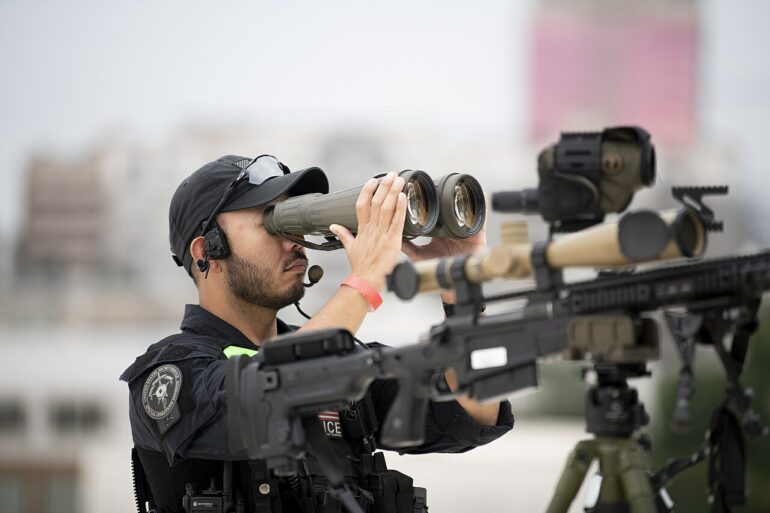

A newly released Department of Homeland Security inspector general report details a series of communication breakdowns and missed opportunities by the Secret Service during the attempted assassination of President Donald Trump at a campaign rally in Butler, Pennsylvania, concluding that the agency failed to identify and respond to the threat before shots were fired.
The 64-page report, released Thursday, found the Secret Service “missed multiple opportunities to detect, prevent, and disrupt” gunman Thomas Crooks’ attack during the July 13, 2024, rally. Among the report’s findings was that a Secret Service counter drone operator searched online for the location of the rooftop where Crooks had been spotted instead of immediately obtaining that information from local law enforcement.
According to the report, local law enforcement contacted the Secret Service and Pennsylvania State Police communications room at 6:09 p.m., warning officials about a suspicious person on the roof of the American Glass Research International (AGR) complex, located approximately 155 yards from the stage where Trump was speaking.
Investigators found that neither the Secret Service communications room supervisor nor the counter drone operator asked local authorities where the AGR complex was located or immediately recognized the situation as a potential threat.
The report states that the communications room supervisor later said he did not recall learning the suspicious individual was on the roof because he had delegated communications regarding the incident to the counter drone operator. According to the report, the supervisor made that decision because radio traffic was especially busy and the counter drone operator, who was seated nearby, offered to assist.
Rather than contacting local law enforcement to determine the building’s location, the counter drone operator searched for the AGR complex online. The report concluded the operator was still searching when Crooks opened fire.
At approximately 6:11 p.m., just two minutes after the Secret Service received the warning about the rooftop suspect, Crooks fired eight shots toward Trump. The president was grazed in the ear, one rally attendee was killed, and others were wounded.
The report states that local law enforcement had been increasingly concerned about the suspect well before the shooting. According to investigators, officers had identified suspicious behavior as early as 5:42 p.m., but Secret Service communications personnel never classified Crooks as an urgent threat before the attack occurred.
The inspector general also found that the officials responsible for protecting Trump while he was on stage were never informed about Crooks’ presence before the shooting.
Investigators concluded that the Secret Service’s failure to establish a joint communications room with local law enforcement played a significant role in the breakdown. As a result, 102 radio transmissions discussing the suspect were never heard by Secret Service personnel.
Among the missed communications was a 5:42 p.m. radio transmission describing “a younger white male long hair lurking around the AGR building” who had been seen using a rangefinder to sight the stage before officers lost sight of him.
Additional radio traffic became increasingly urgent as officers tracked the suspect. At 6:08 p.m., an officer reported, “I have someone on the roof with white shorts.” Moments later, another officer radioed, “He’s armed, I saw him. He’s laying down.” That transmission was followed by warnings to deploy to the AGR building because there was “a male on the roof with a long gun,” just before reports of shots fired.
According to the report, the Secret Service received only five phone calls and three text messages concerning Crooks throughout the incident.
The inspector general concluded that because of those communication failures, Secret Service personnel never alerted Trump’s protective detail about concerns involving the suspicious individual before the shooting began.
The report also examined security preparations before the rally. It found that on July 12, 2024, a site agent proposed placing trucks between the AGR complex and the rally stage to block the line of sight. According to investigators, members of Trump’s campaign staff opposed the proposal because the vehicles would have been “too close to [President Trump’s] press shot.”
The report states the site agent then proposed relocating the trucks to another nearby position that would block a different line of sight, and campaign staff agreed to that alternative.
[READ MORE: Wall Street Journal Editorial Board Slams Trump Family Financial Dealings, Warns of Political Fallout]