

Senate Republicans reportedly scored a modest but notable victory in their long-running effort to advance President Donald Trump’s voter identification and citizenship verification legislation, breathing new life into a proposal that many conservatives had feared was stalled indefinitely.
The development came during the Senate’s overnight vote-a-rama on a $70 billion immigration enforcement package, where Republicans made two separate attempts to attach the Safeguarding American Voter Eligibility (SAVE) America Act to the broader legislation.
Both efforts ultimately failed, but the votes revealed growing support for the measure and highlighted the ongoing debate within the Republican conference over how aggressively to pursue Trump’s legislative priorities.
The first amendment, offered by Sen. Lindsey Graham of South Carolina, sought to attach a modified version of the SAVE America Act. That proposal incorporated several additional policy provisions that Trump had previously called for, including language barring men from competing in women’s sports.
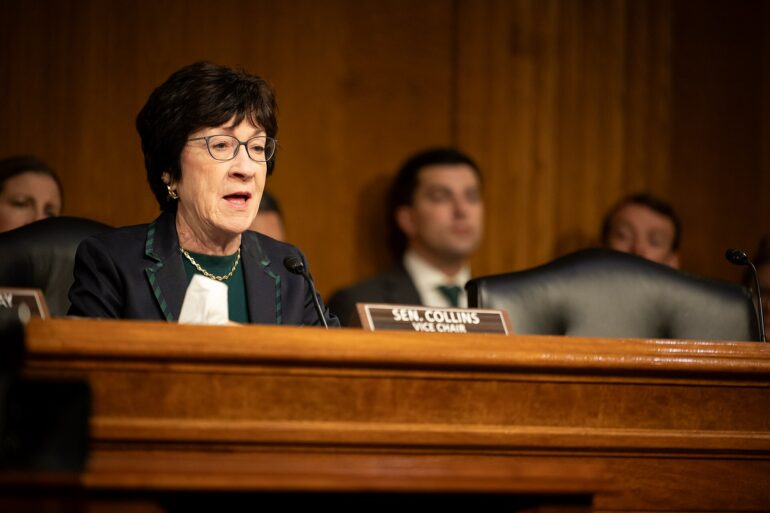
The amendment ran into resistance from both Democrats and a handful of Republicans. Sens. Susan Collins of Maine, Lisa Murkowski of Alaska, Mitch McConnell of Kentucky, and Thom Tillis of North Carolina joined Democrats in opposing the measure.
Their votes prevented the amendment from reaching even the 50-vote threshold Republicans would have needed if they chose to pursue a talking filibuster strategy. Because the amendment also faced the Senate’s 60-vote filibuster hurdle, its path forward was already difficult.
A second effort, led by Sen. Mike Lee of Utah, produced a more encouraging result for supporters of the legislation. Lee offered the original House-passed version of the SAVE America Act, and this time Collins switched sides to support the measure.
That change gave the proposal 50 votes, a symbolic milestone that immediately energized conservatives who have spent months pressing Senate leadership to bring the legislation to the floor.
Lee celebrated the outcome on social media, arguing that the vote demonstrated the bill would have passed if Senate rules allowed a simple majority threshold. With Vice President JD Vance available to cast a tie-breaking vote, Lee contended that the legislation could have been sent to President Trump’s desk were it not for the filibuster.
For supporters, the vote represented the strongest sign yet that the legislation remains viable despite months of inactivity in the Senate.
Conservative lawmakers have repeatedly urged Senate Majority Leader John Thune to pursue a talking filibuster strategy, which would force Democrats to remain on the Senate floor and defend their opposition while potentially allowing Republicans to pass the bill with a simple majority.
Thune, however, has remained cautious. His concerns center on maintaining Republican unity while fending off a barrage of Democratic amendments that could reshape the legislation or affect other elements of Trump’s broader agenda.
Republicans previously staged an extended Senate floor effort in March focused on the SAVE America Act, but momentum behind that campaign gradually faded as attention shifted to other legislative battles.
Another option frequently discussed by supporters is eliminating the legislative filibuster altogether. Trump has periodically urged Senate Republicans to take that step throughout his second term.

Yet many Republicans remain reluctant, warning that removing the filibuster could create consequences they may regret if Democrats regain control of the Senate in the future.
Trump has also directed criticism toward Senate Parliamentarian Elizabeth MacDonough after she ruled that the SAVE America Act could not be included in the immigration package under rules allowing passage by a simple majority vote.
The president has repeatedly called on Senate leadership to replace her, arguing that the ruling stands in the way of legislation he strongly supports.
Thune, however, has shown little interest in taking that route. He noted that parliamentarian rulings have historically benefited and frustrated both parties depending on the issue at hand.
For now, the SAVE America Act remains caught between growing Republican enthusiasm and the procedural barriers that continue to define the Senate. While the latest vote did not deliver final passage, supporters view it as evidence that the legislation still has a path forward, even as internal divisions and Senate rules continue to slow its progress.
[READ MORE: GOP Senators Push Back After Pentagon Religious Policy Sparks Mormon Backlash]