
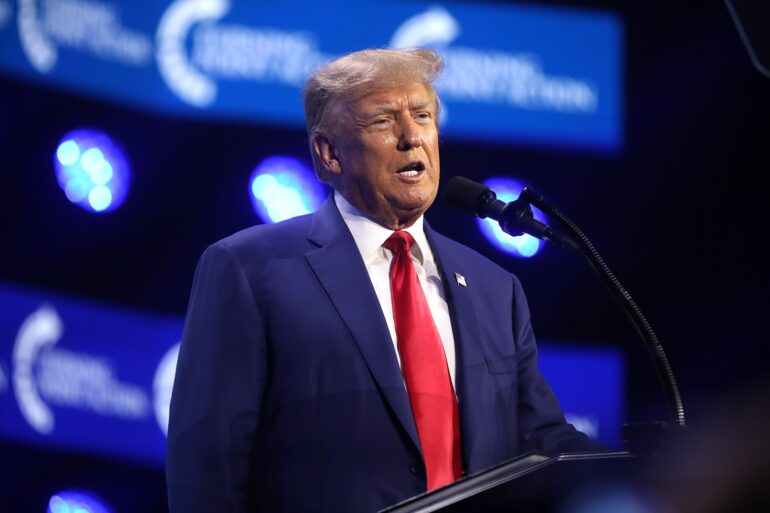

President Donald Trump said Friday that he discussed the possibility of the United States and China working together on artificial intelligence “guardrails” during his summit with Chinese President Xi Jinping, as fears grow in Washington over the risks posed by rapidly advancing AI systems.
Speaking to reporters aboard Air Force One after his meetings in Beijing, Trump said the two leaders explored the idea of establishing safeguards surrounding artificial intelligence technology, though he offered few details about what such cooperation might ultimately involve.
“We talked about possibly working together for guardrails” on AI, Trump said.
When pressed about the nature of those guardrails, the president responded only that they were the kinds of safeguards “that we talk about all the time.”
Artificial intelligence was widely expected to be a major topic during the summit, as China continues racing to compete with the United States in what many policymakers increasingly view as one of the defining technological battles of the century.
Both Washington and Beijing have generally embraced pro-innovation policies with relatively light regulation surrounding AI development. But new systems, particularly Mythos from Anthropic, have intensified concerns inside the U.S. government over how quickly AI capabilities are advancing.
“AI is fantastic,” Trump told reporters Friday. “So many things can happen in terms of health, medicine and operations, everything … military.”
At the same time, the president acknowledged the technology also carries serious dangers.
“So many things can happen, but it’s also got some drawbacks and we’re talking about … we probably will, we’re going to work together,” Trump said.
When a reporter asked whether those concerns involved biological, nuclear, or cyber threats, Trump nodded and replied, “Could be, yeah.”
The remarks reflect growing anxiety inside Washington that AI systems may soon outpace governments’ ability to safely manage them, particularly as the technology becomes increasingly tied to cybersecurity, military planning, and critical infrastructure.
Treasury Secretary Scott Bessent said Thursday that the United States remains in a strong negotiating position because it still leads China in the AI race.
“The two AI superpowers are going to start talking,” Bessent told CNBC. “We’re going to set up a protocol in terms of how do we go forward with best practices for AI to make sure nonstate actors don’t get a hold of these models.”
White House officials earlier this week suggested the administration was also considering establishing a formal communications channel between Washington and Beijing focused specifically on AI developments and risk management.
“One U.S. official” said Sunday that maintaining communication between the two powers is important in areas of intense competition, though the structure and formality of any future channel remains undecided.

It remains unclear whether Trump and Xi formally agreed to create such a system during the summit.
The Biden administration previously launched an official AI dialogue with China in 2023, though those talks reportedly achieved limited results. U.S. officials at the time focused heavily on safety concerns, while Chinese representatives concentrated more on American export restrictions involving advanced AI chips.
The current debate has been intensified by the recent release of Anthropic’s Mythos cybersecurity model. According to the company, the system can identify decades-old vulnerabilities that hackers could potentially exploit against banks, government institutions, and software systems.
The release reportedly rattled the Trump administration, which had previously emphasized maintaining America’s competitive edge in AI development over imposing strict safety regulations.
Questions surrounding advanced semiconductor exports also hovered over the summit. Trump initially told reporters that the possible sale of advanced Nvidia chips to China “didn’t come up” during talks. He later added, however, that “something could happen on that.”
Nvidia CEO Jensen Huang traveled to China alongside Trump and other business leaders. Huang has previously criticized U.S. export controls, arguing they pushed China to accelerate development of its own domestic technology industry.
The growing discussion over AI cooperation highlights an unusual reality emerging between Washington and Beijing: even as both countries compete fiercely for technological dominance, leaders on both sides increasingly appear aware that some forms of advanced technology — especially those touching cyberwarfare, biological threats, and military systems — may carry risks too large for either superpower to fully control alone.