
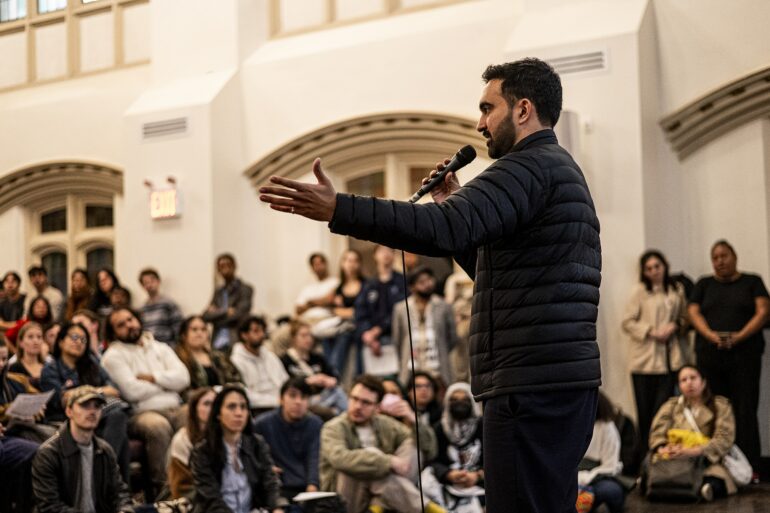

President Donald Trump escalated his criticism of New York City leadership this week, accusing Mayor Zohran Mamdani of “destroying” the city over a newly proposed tax targeting high-value second homes.
In a Thursday post on Truth Social, Trump delivered one of his sharpest rebukes of Mamdani to date, marking a notable shift after months of relatively cordial interactions between the two. “Sadly, Mayor Mamdani is DESTROYING New York! It has no chance! The United States of America should not contribute to its failure,” Trump wrote, warning that the city’s direction could worsen under current policies.
The president focused much of his criticism on what he described as excessive taxation, arguing that the proposed policy reflects a broader pattern. “It will only get WORSE. The TAX, TAX, TAX Policies are SO WRONG,” he added, claiming that residents are already leaving and urging city leaders to reverse course quickly. “History has proven, THIS ‘STUFF’ JUST DOESN’T WORK.”
The proposal at the center of the dispute was unveiled jointly by Mamdani and New York Gov. Kathy Hochul. The plan would impose a new tax on second homes in New York City valued at more than $5 million, with the goal of raising an estimated $500 million in revenue.
Supporters of the measure argue it is a targeted approach aimed at wealthy property owners whose homes often sit vacant for much of the year. Hochul defended the plan by saying that those who can afford multimillion-dollar secondary residences should contribute more to the city’s finances, framing it as a matter of fairness.
Mamdani echoed that argument during a press conference, describing the proposal as part of a broader effort to address the city’s financial challenges. New York is facing a projected budget deficit of $5.4 billion in the upcoming fiscal year, and the mayor said the tax would help close that gap. He emphasized that significant wealth is concentrated in the city even as it confronts what he called a “generational fiscal crisis.”
“We’re talking about the levels of wealth that are storing themselves here in New York City,” Mamdani said, adding that the measure is a key component of ongoing work with the governor to stabilize the city’s finances.
The clash over the tax highlights a long-running ideological divide between Trump and Mamdani, whose relationship has been marked by both sharp rhetoric and occasional cooperation. During his mayoral campaign, Mamdani referred to Trump as a “despot,” while Trump has labeled the mayor, a democratic socialist, a “communist.”

Despite those exchanges, the two have at times struck a more constructive tone, particularly on issues related to affordability. Their first Oval Office meeting last November was described positively by both sides, and a follow-up meeting at the White House in February also reportedly went well.
Still, the latest dispute suggests that any common ground may be limited, especially when it comes to economic policy. As New York grapples with budget pressures and competing visions for how to address them, the debate over taxation is likely to remain front and center.
While city leaders argue that targeted revenue measures are necessary to navigate financial strain, critics warn that aggressive tax policies could drive residents and investment away. The tension reflects a broader challenge facing major cities: balancing fiscal needs without undermining long-term stability—an equation that, much like other high-stakes decisions, rarely offers easy answers.