
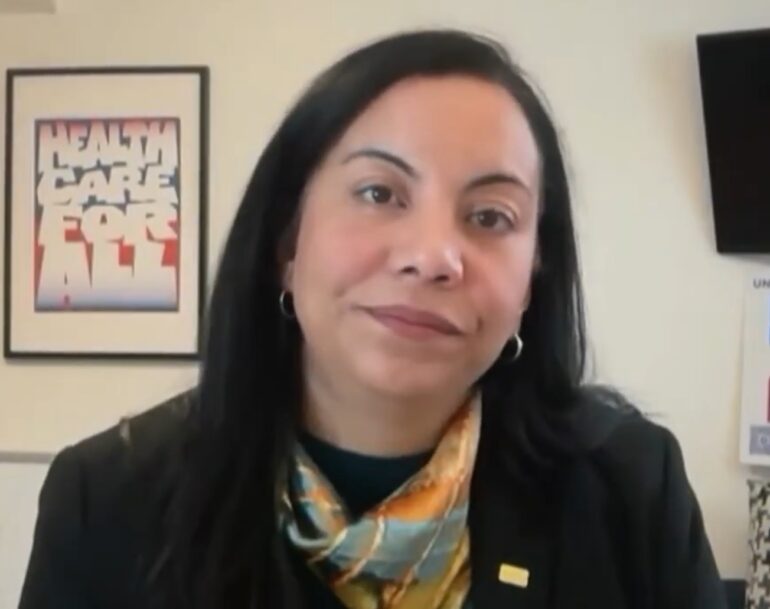

Democrat Analilia Mejia has secured a victory in New Jersey’s 11th Congressional District, according to Decision Desk HQ, succeeding Mikie Sherrill and delivering a notable win for the progressive wing of her party.
Mejia, who previously served as a top aide on Bernie Sanders’s 2020 presidential campaign, defeated Republican Joe Hathaway in Thursday’s special election. The district, located in northern New Jersey, leaned Democratic in recent elections, voting for former Vice President Kamala Harris by nine percentage points in 2024.
With roughly 93 percent of the vote reported early Friday morning, Mejia held a commanding lead of about 20 points, earning 60 percent of the vote to Hathaway’s 40 percent. The margin represents a stronger showing than Harris’s performance in the district, though still within a Democratic-leaning landscape. Sherrill herself had won reelection by a larger margin that same year before stepping down to assume the governorship, triggering the special election.
In a message posted after the race, Mejia thanked voters and emphasized grassroots organizing as the key to her success. “This victory belongs to all of us,” she wrote, pledging to continue advocating for constituents as she prepares to take office for the remainder of Sherrill’s term.
The win adds to a broader pattern of Democratic success in special elections this cycle, with Mejia’s performance contributing to a trend of overperformances compared to prior benchmarks. Still, the race also highlighted ongoing debates within the party and among voters about policy direction and political tone.
Mejia’s path to victory was not without its own surprises. She emerged from a crowded February primary by defeating former Rep. Tom Malinowski, an outcome that signaled strong support among progressive voters despite Malinowski’s higher profile and prior experience in Congress. Democrats pointed in part to the role of the American Israel Public Affairs Committee, whose attacks on Malinowski may have reshaped the dynamics of the race. Mejia later criticized the group’s influence following her primary win.
Backed by prominent progressive figures including Sanders, Sen. Elizabeth Warren, and Rep. Alexandria Ocasio-Cortez, Mejia entered the general election with significant momentum. She also received support from Sherrill, who endorsed her as a successor.
The general election, however, revealed deeper divisions, particularly over foreign policy and rhetoric surrounding Israel. During their lone debate, Hathaway accused Mejia of antisemitism, citing her views on the conflict in Gaza and her response to a question about Jewish self-determination. He also described her positions as “radical” and “socialist.”
Mejia pushed back, defending her stance and drawing a distinction between criticism of a government and criticism of a people. She pledged that, if elected, she would work to protect Jewish constituents and combat antisemitism, while also advocating for adherence to international law.
At the same time, Mejia turned her focus on Hathaway, noting his support for President Donald Trump and arguing that his policies would align with those she believes contribute to rising costs and continued military engagement abroad.

Some analysts noted that while Mejia performed strongly overall, her positions may have encountered resistance in certain areas. NBC News analyst Steve Kornacki pointed to pockets of weaker support in communities with large Jewish populations, suggesting that her views on Israel may have influenced voter sentiment in those areas.
Mejia will now serve the remaining eight months of Sherrill’s term, but the contest is far from over. Both she and Hathaway are expected to compete in upcoming primaries as they seek to secure nominations for a full term in the fall.
The race, while decisive in its outcome, underscores the broader balancing act facing candidates: appealing to a base energized by bold positions while navigating the complexities of issues that resonate deeply with voters, especially when questions of foreign policy and conflict enter the conversation.