
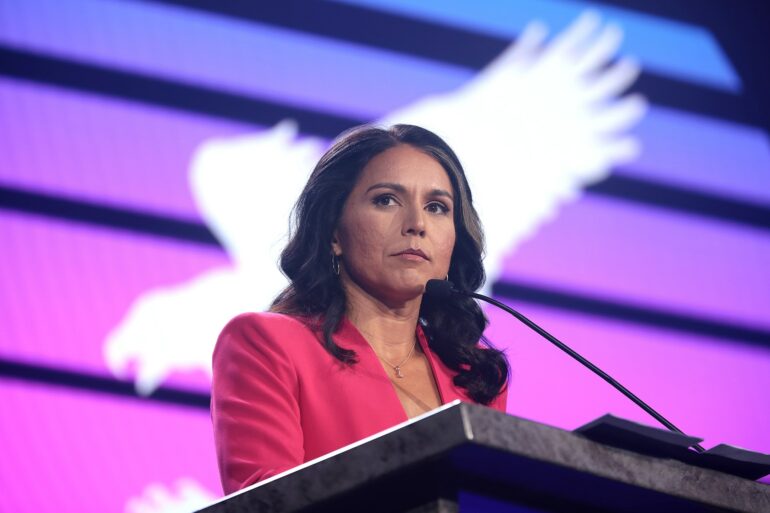

The White House is now reportedly forcefully rejecting reports suggesting Director of National Intelligence Tulsi Gabbard could be the next high-profile departure, following President Donald Trump’s decision to remove Attorney General Pam Bondi on Thursday.
Amid growing speculation, White House Communications Director Steven Cheung issued a clear denial, stating that the president maintains “total confidence” in Gabbard. In a post on the social platform X, Cheung dismissed any suggestion of internal doubt as “totally fake news,” underscoring the administration’s effort to project unity at a time of heightened scrutiny.
“The President has assembled the most talented and impactful Cabinet ever, and they have collectively delivered historic victories on behalf of the American people,” Cheung wrote, reinforcing the administration’s broader message of strength and cohesion.
The denial came in response to a report from The Guardian claiming that Trump had quietly polled members of his Cabinet about potentially replacing Gabbard. According to the report, the alleged concern stemmed from Gabbard’s refusal to criticize Joe Kent, a former deputy who resigned in protest over U.S. military operations in Iran.
Kent’s resignation has added a new layer of tension to an already contentious foreign policy debate. In his letter stepping down, he argued that Iran “posed no imminent threat” to the United States and claimed the conflict was initiated under pressure from Israel and its allies in Washington. His remarks, coming shortly after the United States and Israel launched joint strikes on Iran, have fueled questions not only about internal disagreements but also about the broader rationale behind the operation.
Those strikes, launched on Feb. 28 during ongoing nuclear deal negotiations, have now stretched into a fifth week of conflict. While the administration has defended the action as necessary for national security, lawmakers from both sides have raised concerns about the mission’s objectives and timeline—questions that remain unresolved as the situation continues.
Gabbard herself has found her position under scrutiny in the wake of Kent’s departure. Appearing before the Senate Intelligence Committee days later, she declined to directly answer whether Iran posed an “imminent threat,” a key point of contention in the debate over the strikes. Her careful approach highlighted the delicate balance intelligence officials must maintain when navigating politically charged decisions about war and peace.
In a post on X prior to the hearing, Gabbard made clear that the determination ultimately rested with the president. She stated that Trump had concluded Iran’s government posed an imminent threat and acted accordingly, emphasizing that such judgments fall squarely within the commander in chief’s authority.

“As our Commander in Chief, [Trump] is responsible for determining what is and is not an imminent threat,” she wrote, adding that the president must decide when action is necessary to protect American troops and citizens.
White House Press Secretary Karoline Leavitt echoed that support following Kent’s resignation, reiterating that Trump has full confidence in Gabbard’s leadership.
Still, the episode underscores a broader tension within the administration as it navigates an escalating overseas conflict. While officials emphasize unity and decisive leadership, the debate surrounding Iran—and the costs and consequences of continued military engagement—continues to simmer just beneath the surface.
[READ MORE: Trump Weighs Shake-Up at Justice Department as Pressure Mounts Over Epstein Files and Iran Backdrop]