
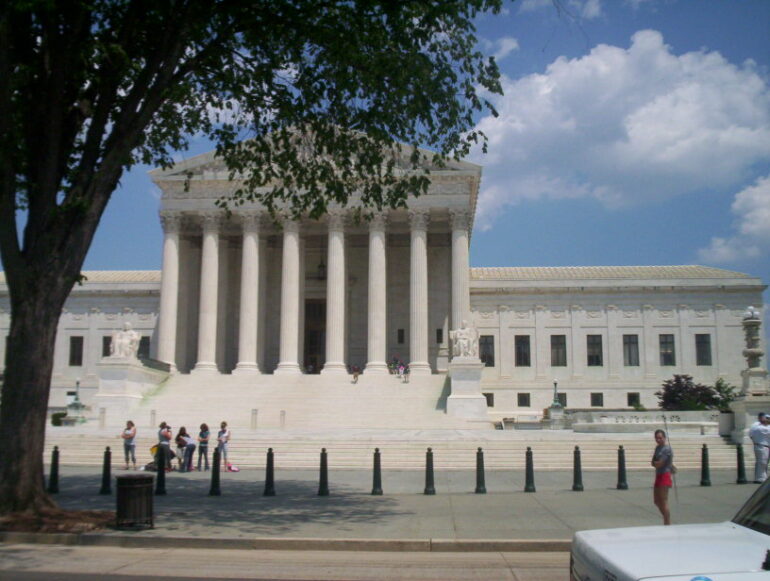

A new Supreme Court decision is now reportedly setting off fresh legal and political battles over how congressional districts are drawn, with Justice Ketanji Brown Jackson sharply objecting to the Court’s latest move involving the Voting Rights Act.
On Monday, the high court sent a Mississippi voting rights case back to a lower court for what it described as “further consideration” in light of its recent ruling in Louisiana v. Callais. That earlier decision rejected what the Court viewed as race-based gerrymandering and narrowed the legal framework surrounding Section 2 of the Voting Rights Act.
Jackson dissented from the Court’s action, arguing that the Mississippi case involved a separate legal issue that had not been addressed in the Louisiana ruling.
“This case presents only the question of Section 2’s private enforceability, which our decision in Louisiana v. Callais … did not address,” Jackson wrote. “Thus I see no basis for vacating the lower court’s judgment.”
The dispute centers on Section 2 of the Voting Rights Act, the federal law that restricts states from drawing voting maps that disadvantage minority voters. For years, the provision has served as a key legal weapon for voting rights groups challenging congressional maps across the country.
But the Supreme Court’s recent ruling appears to significantly narrow the scope of those challenges.
In the Louisiana case, the Court examined whether the state’s 2024 congressional map — which added a second majority-Black district — violated constitutional protections by relying too heavily on race in the redistricting process.
The justices acknowledged that states may consider compliance with the Voting Rights Act as a compelling interest when drawing maps. However, the Court ultimately concluded that the law did not require Louisiana to create a second majority-Black district. The ruling sided with a lower court that had already blocked the state from using the map.

The decision marks another major development in the Court’s ongoing effort to define the limits of race-conscious policymaking, particularly in elections. Supporters of the ruling argue that districts should not be engineered primarily around race, while critics warn the decision could weaken protections for minority voters and make future legal challenges more difficult.
Under the Court’s new standard, plaintiffs challenging district maps may now face a steeper burden in court because they will be required to prove a racially discriminatory motive behind the maps in question.
That shift could have sweeping consequences beyond Louisiana and Mississippi, opening the door to a new round of redistricting fights nationwide as states test the boundaries of the Court’s ruling.
The legal battle also underscores the increasingly high stakes surrounding election law in America, where disputes over district lines have become a central front in the broader political struggle for congressional power. At the same time, the growing reliance on courts to settle deeply divisive political questions continues to fuel concerns about escalating institutional conflict in a country already strained by constant partisan warfare.