
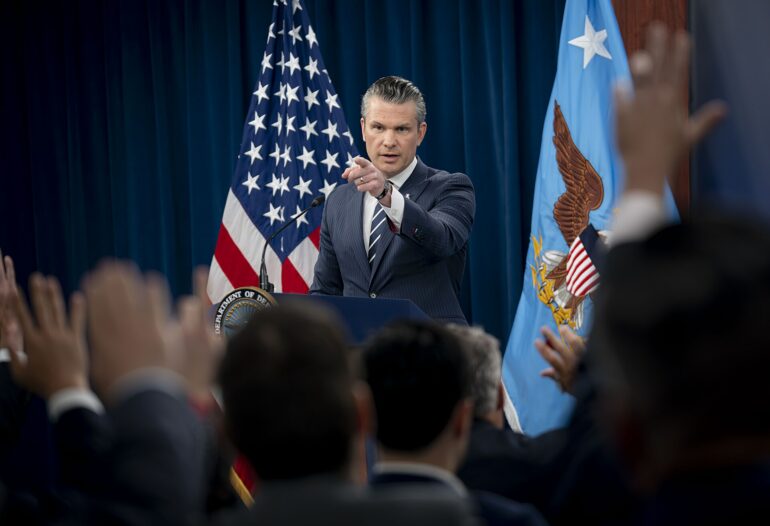

Secretary of War Pete Hegseth announced Thursday a major shift in military policy, lifting the longstanding ban on service members carrying personal firearms on U.S. bases—a move he framed as both a matter of safety and constitutional principle.
Under the new directive, individual base commanders will now have the authority to approve requests from service members seeking to carry privately owned firearms on base. Previously, such permissions were exceedingly rare, with regulations effectively preventing most troops from carrying personal weapons in their day-to-day lives on military installations.
Hegseth emphasized that the policy change reflects a fundamental trust in the men and women of the armed forces, who are already trained to operate weapons at the highest levels.
“The War Department’s uniformed service members are trained at the highest and unwavering standards,” Hegseth said. “These warfighters, entrusted with the safety of our nation, are no less entitled to exercise their God-given right to keep and bear arms than any other American.”
The secretary framed the decision as aligning military policy with the broader rights service members defend overseas. “Our warfighters defend the right of others to carry,” he added. “They should be able to carry themselves.”
At the same time, the directive stops short of a blanket authorization, instead placing responsibility in the hands of base commanders. That layer of oversight suggests an effort to balance expanded rights with command-level discretion, particularly given the unique security concerns on military installations.
Hegseth pointed to a series of troubling incidents in recent years to justify the shift, arguing that threats are not confined to distant battlefields. He cited events at Fort Stewart, Holloman Air Force Base, and Naval Air Station Pensacola as stark reminders that danger can emerge even within the supposed safety of domestic bases.
“Recent events… have made clear that some threats are closer to home than we would like,” Hegseth said. “In these instances, minutes are a lifetime, and our service members have the courage and training to make those precious, short minutes count.”
The prior policy, enforced in part due to the Gun-Free School Zones Act of 1990, largely prohibited privately owned weapons on military property. Critics of that framework have long argued it left trained personnel unable to respond quickly in emergency situations, while supporters maintained it reduced the risk of escalation and accidental harm.
Recent incidents illustrate the complexity of the issue. In August 2025, an Army sergeant at Fort Stewart used a personal handgun to shoot five fellow soldiers before being subdued. Earlier, in March, a domestic-related shooting at Holloman Air Force Base left an active-duty airman injured and a civilian partner dead. And in 2019, a Saudi trainee carried out a terrorist attack at Naval Air Station Pensacola, killing three service members and wounding eight others.
Together, those events underscore both the risks service members face and the difficult balance policymakers must strike. While expanding firearm access may offer troops a means of self-defense in critical moments, it also raises questions about how best to maintain order and prevent violence within the ranks.
Hegseth’s directive ultimately reflects a broader debate—one that weighs individual rights and preparedness against the unpredictable realities of life on base, where the line between protection and danger can be perilously thin.
[READ MORE: Trump Weighs Shake-Up at Justice Department as Pressure Mounts Over Epstein Files and Iran Backdrop]