
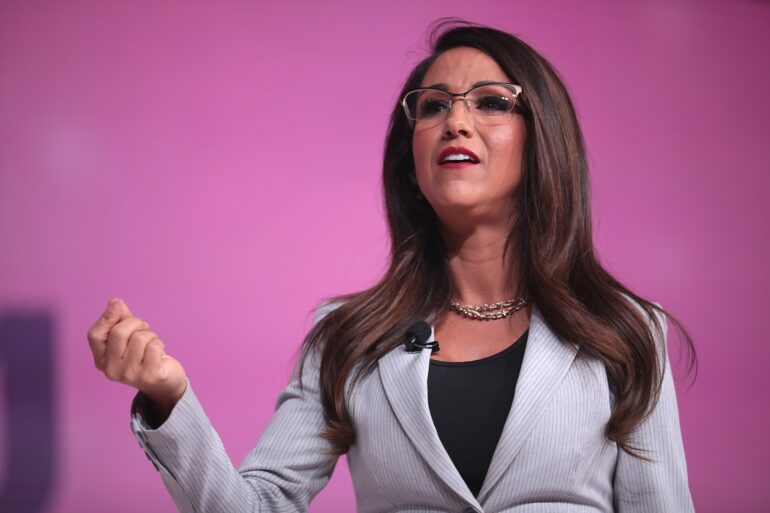

As the price tag of the ongoing Iran conflict continues to climb, a growing divide is emerging in Washington over whether American taxpayers should keep footing the bill. At the center of that debate is Rep. Lauren Boebert (R-CO), who is taking a firm stand against any additional war funding—regardless of the amount.
Speaking on Capitol Hill, Boebert made clear she will not support any supplemental spending package tied to the Iran war, which began on February 28 under President Donald Trump. The Department of Defense is now seeking $200 billion in additional funds to sustain the effort, with the war already costing taxpayers roughly $1 billion per day. That figure does not include the ripple effects hitting Americans at home, including rising gas prices.
“I will not vote for a war supplemental,” Boebert said when asked about the expected funding request. “No. I am a no. I’ve already told leadership.” Her position leaves little room for negotiation, reflecting a broader frustration among some conservatives who are increasingly wary of massive overseas expenditures.
Boebert framed her opposition in stark, populist terms, arguing that Washington’s priorities are out of step with everyday Americans. “I am so tired of spending money elsewhere,” she said. “I am tired of the industrial-war complex getting all of our hard-earned tax dollars.” She pointed to constituents in her home state of Colorado who are struggling to afford basic living expenses, emphasizing the need for what she described as “America First policies.”
Her comments tap into a longstanding concern among fiscal conservatives about unchecked military spending, particularly when domestic economic pressures are mounting. While support for strong national defense remains a cornerstone of Republican policy, the scale and cost of the Iran operation appear to be testing that consensus.
Elsewhere on Capitol Hill, Rep. Scott Perry (R-PA) offered a somewhat different perspective, suggesting that the administration’s $200 billion request may not reflect the final cost. Appearing on CNN later in the day, Perry indicated that the number could ultimately come down.
In a notable twist, Perry also floated the idea that Iran itself should bear the financial burden of the conflict. “I would actually like to see Iran pay for this, whether it’s $20 billion or $200 billion, whatever it is,” he said. He later clarified that such payments would likely have to come from a future Iranian government more aligned with U.S. interests.
The debate over funding is not confined to Republicans. Some prominent Democrats, while publicly expressing opposition to the war, have not ruled out supporting additional funding to sustain it. That position highlights the complicated political reality in Washington, where opposition to military action does not always translate into a willingness to cut off funding once operations are underway.

Still, Boebert’s stance underscores a growing unease with the financial and human costs of prolonged conflict. While she did not directly address broader strategic considerations, her comments reflect a sentiment that endless spending abroad may come at the expense of urgent needs at home.
As Congress prepares to weigh the administration’s request, lawmakers on both sides of the aisle will face a familiar but increasingly uncomfortable question: how much more should the United States invest in a war whose costs continue to rise, even as many Americans feel the strain in their daily lives.
[READ MORE: Trump Rebukes Israel After Gas Field Strike Escalates Tensions in Middle East]