
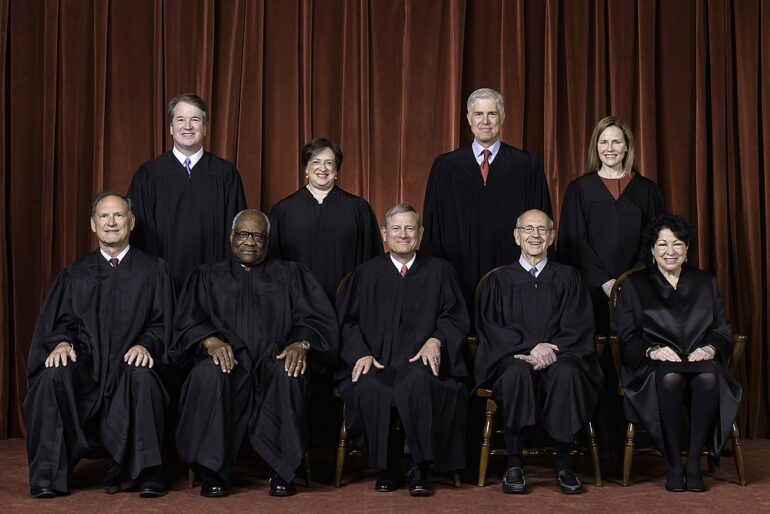

Two Supreme Court justices from opposite ends of the ideological spectrum came together Tuesday to sound the alarm over what they called “serious constitutional problems” in the federal government’s prosecution of a Mexican national who illegally reentered the United States.
Justice Sonia Sotomayor, a liberal appointed by former President Obama, was joined by Justice Neil Gorsuch, President Trump’s first pick for the high court, in questioning how the treatment of Jesus Herrera-Salazar could be reconciled with the Constitution’s double jeopardy protections.
“Should circumstances like these arise again, I encourage courts to avoid the constitutional absurdity that occurred here and give the Double Jeopardy Clause its full weight and meaning,” Sotomayor wrote.
The high court declined to hear Herrera-Salazar’s case on Tuesday, turning it away along with dozens of other appeals. The justices reject the overwhelming majority of the requests they receive.
Sotomayor and Gorsuch did not dissent from the decision to pass on the case. They agreed with the rest of the court that it should not be taken up, pointing out that Herrera-Salazar has already been deported. Still, the pair made clear they hope the facts of his case “are anomalous.”
According to the government, Herrera-Salazar illegally crossed the border on “numerous occasions,” and federal prosecutors went after him twice.
The first time, he was found in Texas in 2020 and sentenced to prison. Later, while he was still on supervised release, a status that legally required him to stay on U.S. soil under the watch of law enforcement, he turned up in Oklahoma. He was then convicted of illegal reentry a second time.
Court documents indicate Herrera-Salazar served both sentences and was removed from the country in 2024.
Even so, he kept up his legal fight, arguing that the second prosecution ran afoul of the Fifth Amendment, which bars anyone from being prosecuted “for the same offence to be twice put in jeopardy of life or limb.”
The 10th U.S. Circuit Court of Appeals rejected that argument, ruling that his two convictions were for separate offenses and that no constitutional violation occurred.
Sotomayor and Gorsuch saw it differently.
“When a defendant is convicted of a crime that involves continuous, uninterrupted conduct, our precedents and the logic of the Double Jeopardy Clause strongly suggest that the Government is barred from charging that defendant with the same continuous crime for a second time simply by focusing on a different time marker,” Sotomayor wrote, with Gorsuch joining her.

“That makes sense,” she added.
The unlikely alliance is nothing new. The Obama appointee and the Trump appointee have previously teamed up to speak out publicly about the treatment of criminal defendants, and Tuesday’s statement marks the latest instance of the two justices finding common ground on constitutional protections for the accused.
While the court’s decision leaves the 10th Circuit’s ruling in place, the two justices’ warning puts lower courts on notice that, in their view, the government stretched the limits of the Double Jeopardy Clause in Herrera-Salazar’s case, and that judges facing similar situations in the future should give the constitutional protection its full force.
[READ MORE: Trump and Rubio Weigh Firing Ambassador Kimberly Guilfoyle Amid Misconduct Allegations]