
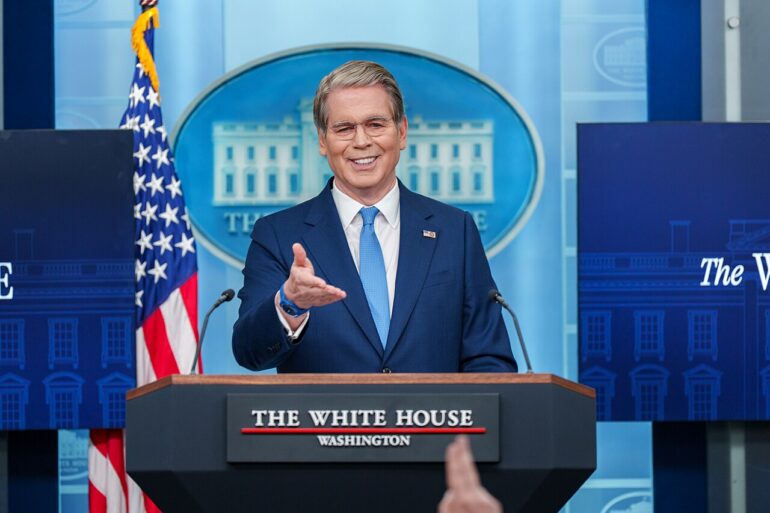

Treasury Secretary Scott Bessent offered Fox News host Jesse Watters a first look at a new $1 coin featuring President Donald Trump during an interview that aired Monday night, highlighting planned currency changes tied to the nation’s upcoming 250th anniversary celebration.
Speaking from the Treasurer’s Office, Bessent showcased several commemorative updates currently in development, including new paper currency bearing the signatures of both President Trump and Bessent, as well as a $1 coin displaying Trump’s likeness.
The coin shown during the interview did not appear to be the separate 24-karat commemorative gold coin approved by the federal Commission of Fine Arts in March. That gold coin features an image of Trump from the waist up with his fists resting on a desk. Instead, the coin Bessent displayed appeared to be the legal-tender $1 coin intended for circulation as part of the nation’s semiquincentennial celebration.
The Trump administration’s White House released candidate designs for that circulating $1 coin in December 2025. However, based on publicly available information, the final design for the semiquincentennial coin does not yet appear to have received approval from the Commission of Fine Arts.
The planned release has also drawn attention because of long-standing federal laws governing the use of living individuals on U.S. currency.
An 1866 law known as the Thayer Amendment prohibits placing the likeness of any living person on U.S. currency, bonds, or other notes. The law originated after Treasury Department official Spencer Clark attempted to place his own image on banknotes that had been intended to honor explorer William Clark. According to the historical account, congressional legislation authorizing the note simply stated it should honor “Clark,” which Spencer Clark interpreted as referring to himself.
Federal law governing presidential coins also includes restrictions. The Presidential $1 Coin Act of 2005 states that a president must have been deceased for at least two years before being honored on a coin under that program.
During his conversation with Watters, Bessent argued that the rules affecting paper currency differ from those governing certain commemorative coins.
“As Treasury Secretary, I only have two mandates: The currency has to say, ‘In God We Trust,’ somewhere on it, and there cannot be an image of a living person,” Bessent said while explaining what he described as the distinction between paper money and coins.
He pointed out that the new paper currency does not feature Trump’s portrait but instead includes the president’s signature.
“But, we have the president’s signature, which again, I think it is appropriate for the 250th,” Bessent said.

He also referenced a historical example to support the commemorative coin, noting that a Calvin Coolidge coin was issued during the nation’s 150th anniversary celebration.
“During that 150th, there was a Calvin Coolidge coin,” Bessent told Watters. “So, we can put living people’s images on a coin.”
The interview provided an early glimpse at the Treasury Department’s planned commemorative currency as preparations continue for America’s 250th anniversary, while questions surrounding the final approval of the circulating $1 coin’s design remain unresolved based on publicly available information.
[READ MORE: Walz Pardon of Convicted Child Rapist Sparks Outrage]