
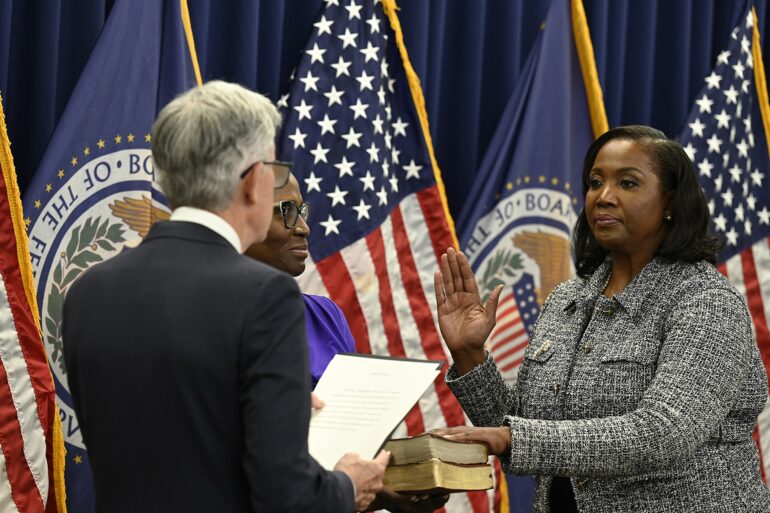

The Supreme Court ruled Monday that President Donald Trump does not currently have the authority to remove Federal Reserve Governor Lisa Cook from the central bank, allowing her to remain on the Federal Reserve’s Board of Governors while her legal challenge continues through the courts.
In a narrow 5-4 decision, the high court declined Trump’s request to halt a lower federal court ruling that had blocked Cook’s dismissal. The ruling means Cook will continue serving on the Federal Reserve as the lawsuit over her removal moves forward, though the justices stopped short of deciding the broader constitutional question of whether Trump ultimately has the authority to fire her or any other Federal Reserve governor.
Chief Justice John Roberts authored the majority opinion. He was joined by fellow conservative Justice Brett Kavanaugh and the court’s three liberal justices: Elena Kagan, Sonia Sotomayor, and Ketanji Brown Jackson. The court’s remaining four conservative justices dissented.
The ruling leaves unresolved one of the key issues surrounding the dispute: the extent of presidential authority over members of the Federal Reserve’s Board of Governors. Rather than settling that question, the court focused only on whether Cook could remain in her position while her legal challenge proceeds.
The case stems from Trump’s decision nearly nine months ago to fire Cook. At the time, the president said the move was based on allegations that she had committed mortgage fraud before joining the Federal Reserve. Those allegations had been made by a Trump-appointed official.
Despite Trump’s announcement, Cook never left her position. A federal district court judge initially blocked her removal, allowing her to remain on the Board of Governors while the courts considered her lawsuit. The Supreme Court later upheld that protection, and Monday’s ruling continues to keep the lower court’s order in place.
Cook’s lawsuit challenges the legality of Trump’s attempt to remove her from the Federal Reserve before the end of her term.
Although Trump publicly cited the mortgage fraud allegation as the basis for the dismissal, Cook and others believed the president’s true motivation was tied to monetary policy.
According to those concerns, Trump sought to remove Cook because she declined to support the interest rate cuts he had repeatedly urged the Federal Reserve to adopt during the first nine months of his second term in office.
The Federal Reserve has long operated with a degree of independence from the White House, and federal law places limits on a president’s authority to remove members of its governing board.

Under the Federal Reserve Act, a president may remove a Federal Reserve governor only “for cause,” a legal standard that has become central to the ongoing dispute.
For now, the Supreme Court’s decision leaves Cook in office while the lower courts continue weighing whether Trump’s effort to remove her complied with that requirement. The justices made clear, however, that Monday’s ruling does not determine whether the president ultimately has the legal authority to remove Cook or any other Federal Reserve governor once the case is fully resolved.
[READ MORE: Laura Loomer Laments Direction of GOP, Says Party Has Become “Unrecognizable”]