
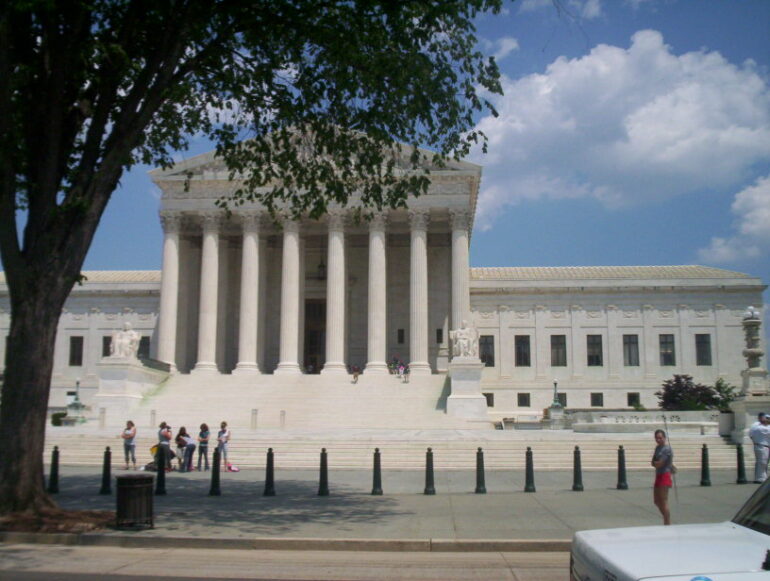

The Supreme Court delivered a unanimous ruling Thursday that limits the federal government’s ability to prosecute individuals for firearm possession based solely on their regular use of marijuana, marking another significant development in the Court’s ongoing interpretation of the Second Amendment.
Writing for the Court, Justice Neil Gorsuch concluded that the government failed to justify its prosecution under the constitutional test established by the Court’s conservative majority in recent years. The decision centered on whether federal authorities can criminally charge someone for possessing a firearm simply because they are an “unlawful user” of a controlled substance.
The case involved Ali Hemani, a dual U.S.-Pakistani citizen who was indicted after law enforcement searched his home and discovered a Glock 9mm pistol along with marijuana. Authorities also found cocaine during the search, but the firearm charge was based solely on Hemani’s marijuana use. According to court records, Hemani admitted to investigators that he smoked marijuana every other day.
Notably, the government did not argue that Hemani was under the influence of marijuana at the time officers found the firearm. Instead, prosecutors relied on a federal statute that makes it a crime for someone who is an unlawful user of, or addicted to, a controlled substance to possess a gun.
Hemani challenged the charge by pointing to the Supreme Court’s 2022 Second Amendment framework, which requires modern firearm regulations to be supported by a historical tradition of similar restrictions. That standard has become a key battleground in legal disputes involving gun rights and federal regulations.
In defending the law, the Trump administration argued that the statute was consistent with historical regulations that restricted firearm possession by habitual drunkards during the nation’s founding era. The government maintained that those laws provided a suitable historical analogue for modern restrictions on regular drug users.
The Court disagreed.
“To square that expansive theory with the Second Amendment, the government invites us to draw an analogy between its present regulation and historical laws addressing habitual drunkards,” Gorsuch wrote. He concluded that the comparison fell short.
According to the opinion, the historical laws cited by the government targeted different groups, served different purposes, and operated differently from the federal statute at issue. Because of those distinctions, the Court found the government had not met its burden of demonstrating that the prosecution complied with the Second Amendment.
“The historical laws on which it relies targeted different kinds of people, did so for different reasons, and operated in different ways,” Gorsuch wrote. “And faced with all these shortcomings in the government’s submission, we cannot say it has carried its conceded burden of showing its prosecution of Mr. Hemani complies with the Second Amendment.”

While the ruling raises the threshold for future prosecutions under the statute, it does not eliminate the possibility of criminal charges in every circumstance. The decision leaves open the possibility that prosecutors could still secure convictions if they can show a defendant was actively using illegal drugs at the time they possessed a firearm.
The case also drew attention because similar charges had previously been brought against Hunter Biden before he received a pardon from his father.
In a period when debates over constitutional rights, federal authority, and public safety continue to dominate national politics, the Court’s decision underscores its insistence that modern firearm restrictions must be rooted in historical precedent. At the same time, the ruling serves as a reminder that government efforts to regulate dangerous behavior must still satisfy constitutional safeguards, even as lawmakers grapple with the broader social consequences of drug use and the challenges of maintaining public order without unnecessarily expanding criminal enforcement.
[READ MORE: Trump Halts DNI Confirmation Push Amid FISA Standoff, Demands Election Measure Be Included]