
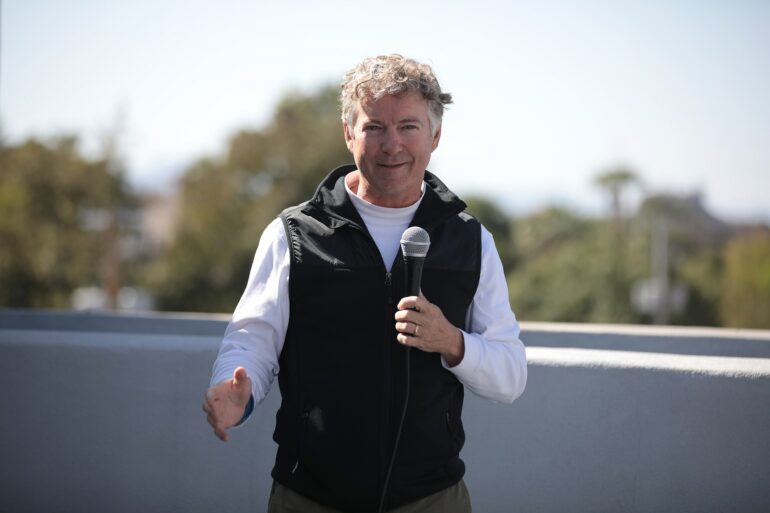

Sen. Rand Paul (R-Ky.) argued Tuesday that the United States is in a weaker position than before President Donald Trump launched military operations against Iran, saying the conflict produced battlefield gains but created new strategic challenges.
Appearing on MSNBC’s Morning Joe, Paul made clear he opposed the military campaign from the outset.
“This is a war of choice, and it wouldn’t have been my choice,” Paul said.
While acknowledging the effectiveness of the U.S. military campaign, Paul argued that the broader consequences have outweighed those successes.
“I think if you look at it objectively, one step forward—we decimated their military—but two steps backwards in that they militarized the Strait [of Hormuz],” the Kentucky senator said.
Paul said the Strait of Hormuz had never previously been militarized and argued that any lasting diplomatic progress will require reversing that development before negotiations can truly move forward.
“The Strait has never been militarized, and I think really, no negotiations go forward until you get a demilitarization of the Strait,” Paul said. “And you will still have to negotiate to get any nuclear achievement, despite the military victory.”
Based on those developments, Paul concluded that the United States is now in a less favorable position than before the conflict began.
“So I think by any objective viewing, we are worse off than we were before the war,” he said.
Morning Joe co-host Willie Geist responded that many Americans would likely agree with Paul’s assessment.
The senator’s remarks came just two days after President Trump announced that a new agreement to end the conflict is “imminent.”
According to Trump, the anticipated deal would accomplish two of his administration’s primary objectives: fully reopening the Strait of Hormuz and securing a guarantee that Iran never obtains a nuclear weapon.
Speaking to reporters aboard Air Force One, Trump also said he had been prepared to authorize what he described as the “biggest attack since World War II” before deciding against it after Iran’s leaders appealed for time to negotiate a deal.
Iranian officials later rejected Trump’s characterization of those events. Trump responded by accusing the country’s leadership of being “unbelievably duplicitous.”

During the interview, Geist also referenced Paul’s recent efforts to limit the president’s authority as commander in chief to engage in military action.
Paul argued that the nation’s founders never intended for a single individual to possess such broad authority to wage war without greater checks on executive power.
Looking ahead, the senator said he believes diplomacy remains possible and outlined the type of agreement he would like to see between the United States and Iran.
Paul said he supports a deal in which Iran would surrender its enriched uranium in exchange for the United States lifting trade sanctions.
“I think there is a possibility for peace,” Paul said. “But there is some in my party who don’t want any peace and want it to go on until there’s a regime change.”
He warned that pursuing regime change could prolong the conflict, adding, “I think that could be a long time.”
[READ MORE: Rep. Marcy Kaptur Hospitalized After Hit-and-Run Crash While Traveling to Church]