
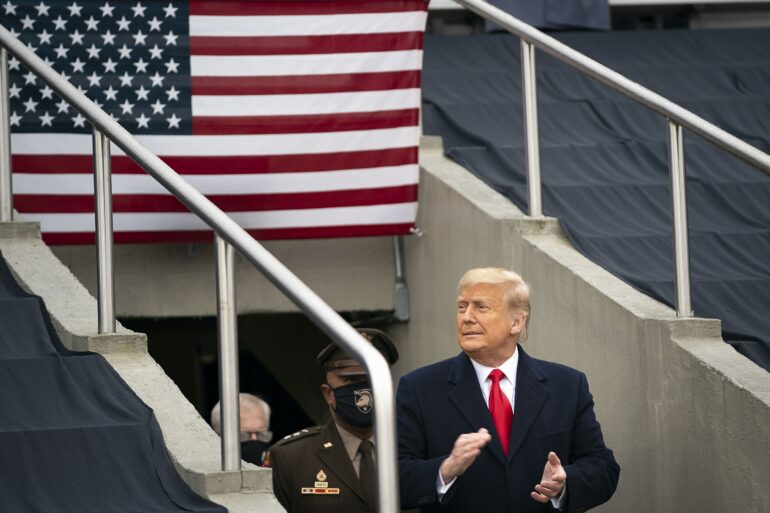

President Donald Trump appears increasingly unwilling to tolerate what aides describe as a frustrating “no deal, no war” stalemate with Iran, signaling a shift toward more assertive measures that could either force diplomacy forward or risk reigniting open conflict.
“The president wants action. He doesn’t want to sit still. He wants pressure. He wants a deal,” a senior U.S. official told Axios, capturing the administration’s sense of urgency as negotiations drag on without resolution.
At the center of this evolving strategy is a newly launched effort dubbed “Project Freedom,” aimed at securing maritime passage through the Strait of Hormuz, a critical chokepoint for global shipping. While Trump was presented with a more aggressive option last week — sending naval vessels through the strait to open it by force — he ultimately chose a more restrained approach, at least for now.
Beginning Monday, the U.S. Navy has been tasked with assisting commercial vessels, including U.S.-flagged ships, by advising them on how to avoid mines and positioning forces nearby to respond if Iran launches attacks. Officials emphasize that there are currently no plans for full naval escorts, though U.S. ships and aircraft will remain close enough to intervene if necessary.
According to U.S. Central Command, the operation will involve guided-missile destroyers, drones, more than 100 aircraft across land and sea, and roughly 15,000 troops. Rules of engagement have also been adjusted, allowing U.S. forces to strike immediate threats, such as Iranian missile positions or fast boats operated by the Islamic Revolutionary Guard Corps.
Supporters of the move frame it as a calculated step designed to shift leverage without immediately triggering a wider war. One source close to the president described the effort as “the beginning of a process that could lead to a confrontation,” while also arguing that a so-called humanitarian mission to free stranded ships could give Washington greater legitimacy if Iran responds aggressively.
Still, the risks are hard to ignore. A more expansive plan presented by CENTCOM Commander Adm. Brad Cooper would have involved direct naval passage through the strait and immediate retaliation against Iranian forces if attacked — a move that could have rapidly escalated into a broader regional war. Trump’s decision to hold back, at least initially, reflects an awareness of those dangers, even as pressure mounts.
Iran, for its part, has already shown signs of resistance. Officials there have warned that U.S. involvement in the strait would violate the ceasefire, with Iranian lawmaker Ebrahim Azizi threatening retaliation. Iranian forces have also reportedly targeted vessels in the region in recent days, raising concerns that even limited U.S. actions could spark unintended consequences.
On Monday, Iran’s military cautioned that “U.S. aggressive actions will only complicate the current situation” and urged commercial ships to coordinate with Iranian authorities before entering the strait. Meanwhile, conflicting claims emerged after Iranian media alleged missile strikes on a U.S. Navy ship — claims swiftly denied by U.S. Central Command.
Despite the military posturing, diplomatic channels remain open. Trump envoys Jared Kushner and Steve Witkoff continue to exchange proposals with Iran’s foreign minister, Abbas Araghchi, though progress appears slow and uncertain. “There are talks. There are offers. We don’t like theirs. They don’t like ours,” one senior official said, adding that communication challenges have further delayed negotiations.

The administration itself appears divided on the prospects for a deal. Witkoff has reportedly maintained an optimistic outlook, urging continued engagement, while other officials are far more skeptical.
For now, the outcome remains unclear. What is evident is that the administration’s latest move walks a narrow line — applying pressure in hopes of securing a deal, while inching closer to a confrontation that could undo the fragile pause in hostilities.
As one senior official put it bluntly: the U.S. may soon find itself facing a decisive moment — either the emergence of a viable agreement, or a dramatic escalation that could plunge the region back into war.