
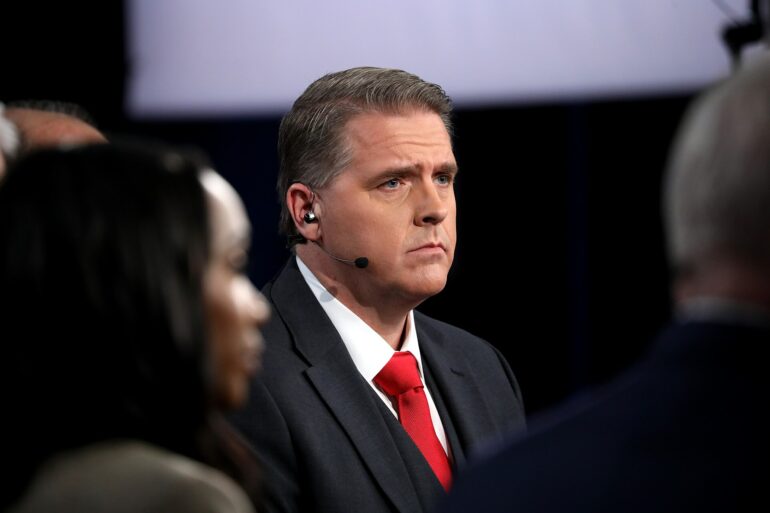

A tense exchange on CNN NewsNight quickly spiraled into a viral moment this week, as a heated debate over U.S. military strategy devolved into personal insults and an on-air outburst that captured widespread attention online.
The confrontation involved Scott Jennings, a Republican political commentator, and Adam Mockler, an outspoken critic of President Donald Trump. While the viral clip showed Jennings angrily telling Mockler to “Get your f*cking hand out of my face,” a closer look at the full segment reveals that tensions had been building for several minutes before the breaking point.
During Thursday’s broadcast, Mockler pressed Jennings on the effectiveness of the current war effort, framing his argument around a central question: what political concessions, if any, had been achieved. “The purpose of a war is to extract political concessions from the enemy,” Mockler said, repeatedly challenging Jennings to name a single example.
Jennings, appearing increasingly frustrated, attempted to respond but also took aim at Mockler personally. At one point, he quipped that Mockler was “up past your bedtime,” prompting host Abby Phillip to step in and urge the panel to avoid personal attacks. The exchange underscored how quickly substantive policy discussions can give way to sharp rhetoric, particularly on high-stakes issues like war.
The tension didn’t ease. Moments later, Jennings turned his criticism toward another panelist, Kat Abughazaleh, before circling back to Mockler with another jab, comparing him to a “gnat.” Mockler fired back, accusing Jennings of defending a costly and failing war, arguing that it could saddle the country with “trillions and trillions of dollars more in debt.”
As the debate intensified, Mockler continued pressing for specifics, reiterating his demand for a concrete political outcome. Jennings countered by defending the broader objective of the military effort, emphasizing the goal of preventing terrorists or hostile regimes from obtaining nuclear weapons capable of threatening the United States, its allies, and global stability.
Still, Mockler remained unconvinced, interpreting Jennings’ response as an inability to directly answer the question. The repeated back-and-forth eventually culminated in the now-viral moment, when Jennings, clearly agitated, lashed out over Mockler’s gestures during the argument.

Phillip quickly intervened, calling for calm and reminding the panel that they were engaged in a debate, not a personal confrontation. Another panelist, Geraldo Rivera, attempted to defuse the situation with a remark referencing past on-air clashes, though the tension lingered.
Beyond the viral clip, the exchange reflects a broader divide not just in tone, but in how Americans view military engagement. Jennings’ focus on long-term security threats contrasts sharply with Mockler’s insistence on measurable outcomes and tangible results. The clash, while dramatic, mirrors a deeper national conversation about the costs, goals, and limits of war.
In the end, what began as a policy discussion became a reminder of how emotionally charged these issues remain. As the debate over military strategy continues, moments like this highlight the challenge of balancing strong convictions with civil discourse—especially when the stakes involve not just politics, but the direction of the country itself.