
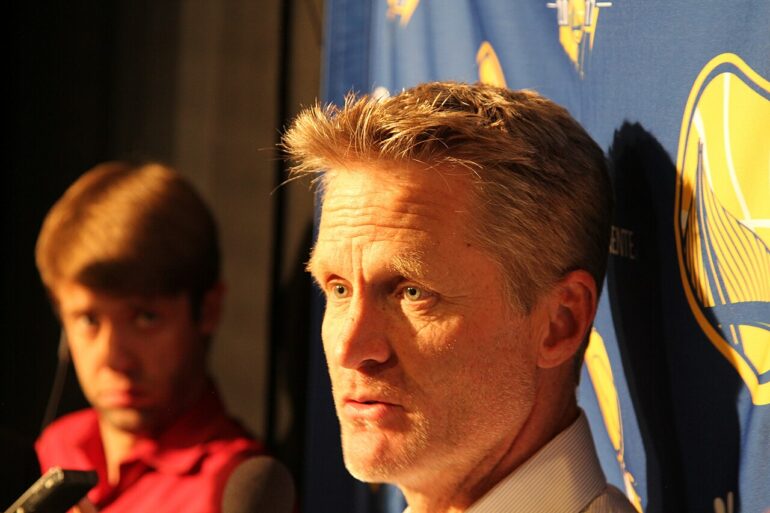

For years, Golden State Warriors head coach Steve Kerr has been one of the NBA’s most outspoken political voices, rarely missing an opportunity to weigh in on contentious national issues. But in a recent interview with The New Yorker, Kerr sounded less like a figure eager to lecture and more like one recalibrating after years of criticism and growing scrutiny.
The lengthy sit-down with New Yorker staff writer Charles Bethea was revealing, though not necessarily in the way the publication may have intended. Bethea’s admiration for Kerr was evident from the outset, praising him as “refreshingly outspoken” and framing his past comments—such as his reaction to the 2022 Uvalde tragedy—as “informed and impassioned advocacy.” The tone signaled a sympathetic platform rather than a challenging interview, with questions that appeared designed to affirm rather than probe.
Yet even in that friendly setting, Kerr struck a noticeably more restrained tone. When discussing past remarks, he acknowledged that he needs to do a better job of representing his organization without making issues overly personal. He also expressed regret for calling President Donald Trump a “buffoon,” suggesting that focusing on policy and values is more productive than resorting to personal attacks.
Perhaps most notably, Kerr addressed criticism over his previous comments on Hong Kong, an issue that has long raised questions about the NBA’s willingness to confront China’s human rights record. Kerr admitted his earlier response was “really weak,” conceding that he had been trying to “walk the company line” and avoid upsetting the league. The admission marked a rare moment of candor, though it went largely unchallenged by Bethea, who quickly shifted the conversation back to more favorable ground.
This shift in tone comes amid reports that Kerr’s frequent political commentary has not been universally embraced within his own organization. NBA reporters Marc Spears and Nick Friedell have indicated that Kerr’s outspoken approach has, at times, created internal frustration, even within a league often aligned with left-leaning viewpoints.
Kerr has also shown a willingness to walk back past statements when directly challenged. Earlier this year, following comments about Immigration and Customs Enforcement and a high-profile shooting case, Kerr admitted he had “misspoken,” acknowledged inaccuracies, and apologized for spreading misinformation. It was a notable departure from the certainty that has often characterized his public remarks.
The contrast with others in the league has been striking. When faced with similar scrutiny, then-Milwaukee Bucks head coach Doc Rivers chose to double down rather than retreat, underscoring a divide in how figures within the NBA respond to criticism.
None of this suggests that Kerr has abandoned his political views. He remains a consistent voice on the issues he cares about and continues to speak out. But the tone of his New Yorker interview hints at a more cautious approach—one shaped not by a change in beliefs, but by the reality that pushback is no longer guaranteed to be absent.
In a sports world where commentary on national issues has become increasingly common, Kerr’s evolution may reflect a broader recognition: speaking out carries consequences, and even the most supportive audiences cannot always shield public figures from accountability.