
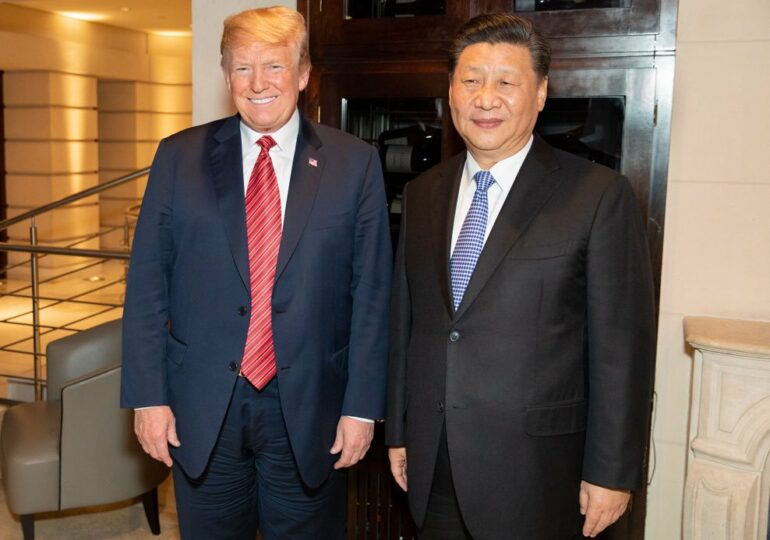

President Donald Trump said Wednesday that China has agreed not to send weapons to Iran, even as reports suggested Beijing had been considering supplying Tehran with new air defense systems.
The claim comes amid rising tensions in the region and a U.S.-led blockade of Iranian ports, a move that has drawn sharp criticism from Chinese officials.
In a series of remarks, Trump projected confidence in his relationship with Chinese President Xi Jinping, predicting a warm reception when the two leaders meet in Beijing on May 14-15. “President Xi will give me a big, fat, hug when I get there in a few weeks,” Trump said, adding that the two nations are “working together smartly, and very well.”
The president also asserted that China is “very happy” with his efforts to permanently open the Strait of Hormuz, a critical global shipping lane through which a significant portion of the world’s oil supply passes. China relies heavily on the route, with roughly 45-50% of its crude imports moving through the strait each year.
Despite Trump’s optimism, Chinese officials have taken a far less enthusiastic tone. On Tuesday, a spokesperson for China’s Foreign Affairs Ministry criticized the U.S. blockade as “dangerous and irresponsible,” warning that such actions could escalate tensions and threaten the already fragile ceasefire in the region. The spokesperson said the move risks undermining navigation security in one of the world’s most vital waterways.
The blockade itself was confirmed by Adm. Brad Cooper, commander of U.S. Central Command, who stated that Iranian ports had been fully cut off as part of a pressure campaign against Tehran. Trump ordered the action over the weekend after Iran demanded tolls for ships passing through the strait while allowing its own vessels to move freely.
While the administration has framed the blockade as a necessary step to restore order, the situation underscores the delicate balance between deterrence and escalation. Trump himself appeared to acknowledge the stakes, remarking that cooperation “beats fighting,” even as he emphasized that the United States remains prepared for conflict if necessary.
Behind the scenes, concerns have lingered about China’s potential role in the conflict. U.S. intelligence reports have indicated that Beijing may have been preparing to send MANPADs—shoulder-fired anti-air missile systems—to Iran to bolster its defenses against possible American strikes. Trump said he personally wrote to Xi urging him not to follow through, and claimed the Chinese leader responded with assurances that no such transfer would take place.
“Look, there’s never been anybody tougher in China than me,” Trump said in a separate interview, while also stressing the importance of maintaining a functional relationship with Xi.
Diplomatic efforts to resolve the broader conflict have so far fallen short. Vice President JD Vance recently led negotiations with Iranian officials in Islamabad, Pakistan, but the talks failed to produce a comprehensive agreement.
Trump has indicated that securing concessions on Iran’s nuclear program remains his top priority.
Even as tensions persist, the president suggested that the conflict may be nearing an end, telling Fox News Business that the war is “very close to over.”
His upcoming visit to Beijing, the first by a U.S. president in nearly a decade, could prove a pivotal moment in determining whether cooperation between global powers can ease the crisis—or whether the standoff continues to drift toward deeper confrontation.