
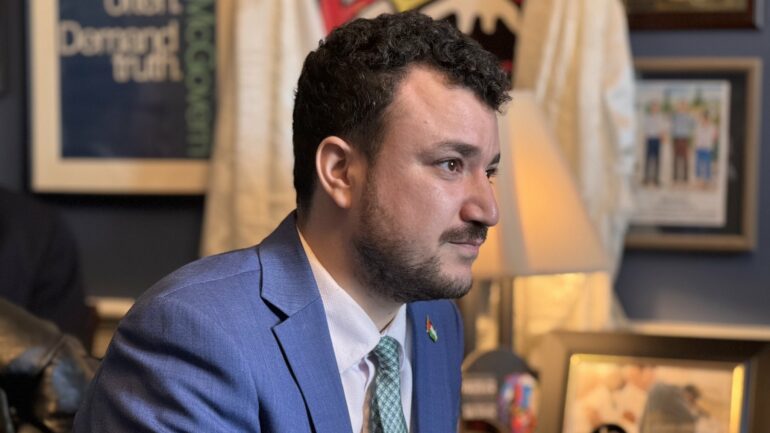

The Board of Immigration Appeals (BIA) has now reportedly issued a final order of removal for Mahmoud Khalil, marking a significant development in a closely watched immigration case that has drawn sharp political and legal debate. According to Khalil’s attorneys, the decision came Thursday after the board denied his request to dismiss the deportation proceedings.
Although the BIA’s rulings are not made public, Khalil’s legal team disclosed the outcome and sharply criticized the decision, describing it as politically motivated. Khalil himself pushed back forcefully, arguing he had committed no crime and broken no law. He maintained that his only offense was speaking out against what he described as genocide in Palestine, accusing the administration of weaponizing the immigration system in response.
Despite the removal order, Khalil will not be detained or deported at this time. A separate federal case he filed against the Trump administration remains ongoing, effectively pausing any immediate enforcement action while the courts continue to weigh broader constitutional questions.
Khalil first came into the national spotlight as one of the leading student figures in the pro-Palestinian encampment at Columbia University in 2024. His activism eventually drew the attention of federal authorities, and he was arrested last year by the Trump administration. Officials alleged he posed a threat to U.S. foreign policy and cited supposed ties to terrorist groups. Khalil was later released after spending several months in custody, as his legal challenges moved forward.
The BIA ultimately sided with the government’s position, agreeing that Khalil could be deported based on a determination by Secretary of State Marco Rubio that he represented a foreign policy risk. However, Khalil’s lawyers point out that a federal district court previously suggested that using such reasoning as the basis for deportation is likely unconstitutional, setting up a potential clash between immigration authorities and the federal judiciary.
Khalil’s legal team has framed the case as part of a broader pattern, arguing that immigration courts—operating under the executive branch—have increasingly tilted against noncitizens. They claim recent decisions reflect a system that has become more political in nature, raising concerns about fairness and due process.
Lead attorney Marc Van Der Hout did not mince words, calling the ruling unprecedented in his decades of experience. He argued the decision lacks support in the record and violates a prior federal court order. Van Der Hout also contended that federal courts have already found evidence suggesting Khalil was targeted because of his speech, adding that additional proof of alleged retaliation may yet emerge.
At the same time, the legal battle has not been without setbacks for Khalil. An appeals court recently ruled that a district judge exceeded their authority by ordering his release from custody, stating that immigration courts must first handle the case before federal courts can intervene. That decision underscores the complex legal terrain surrounding immigration enforcement, where overlapping jurisdictions can complicate even straightforward questions of law.
As the case continues, it highlights not only the tension between national security concerns and individual rights, but also the broader debate over how immigration laws are enforced. While the government maintains its actions are rooted in protecting foreign policy interests, critics argue that such cases risk blurring the line between legitimate enforcement and the suppression of dissent—an issue that remains far from settled.
[READ MORE: Megyn Kelly Slams Trump as ‘Gullible’ Over Iran War Decisions, Questions Path to Conflict]