
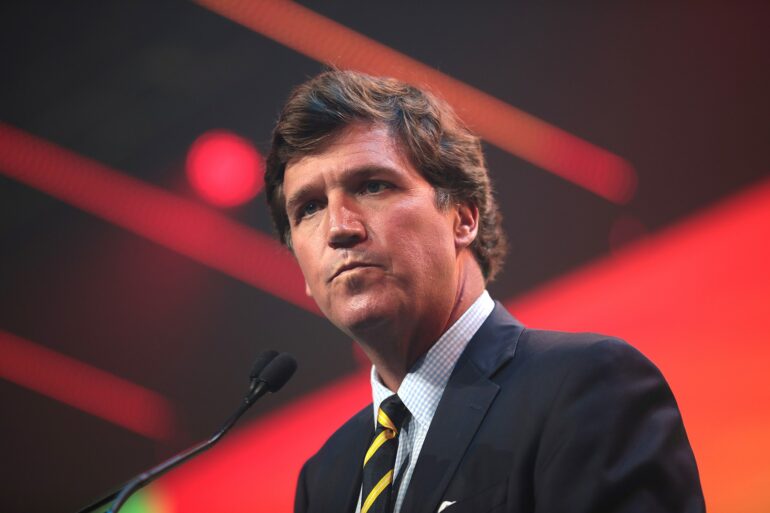

President Donald Trump reportedly escalated his public break with former ally Tucker Carlson on Wednesday, sharing a sharply critical opinion piece that accuses the conservative commentator of betraying both the president and the broader America First movement.
In a series of late-night posts on Truth Social, Trump highlighted a column from the New York Post authored by Douglas Murray, a writer known for his defense of neoconservative foreign policy. The article paints Carlson as a “deranged” figure who has turned against Trump while promoting controversial voices and viewpoints on his independent media platform.
Murray’s piece alleges that while Trump has focused on defending U.S. allies in the Middle East, Carlson has spent his time attempting to shift the MAGA base away from that position. The column accuses Carlson of platforming individuals described as Holocaust deniers, antisemites, Islamic extremists, and World War II revisionists through his online show.
The critique goes further, claiming that Carlson has developed an intense fixation on Israel and related issues in recent years, particularly since his departure from Fox News. According to Murray, that focus has evolved into what he describes as a broader hostility toward the president’s approach to Iran, culminating in open opposition to Trump’s current foreign policy.
For Trump, the dispute appears to center not just on personality, but on direction. The president has repeatedly defended his handling of the Iran conflict and emphasized the importance of standing by regional allies. Carlson, by contrast, has emerged as a vocal critic of the administration’s war posture—an issue that has increasingly divided voices on the right.
Speaking last month in an interview with ABC News’ Jonathan Karl, Trump dismissed Carlson in blunt terms, saying the former host had “lost his way” and no longer represented the principles of the MAGA movement. Trump argued that Carlson lacks the understanding needed to grasp the goals of America First policies, framing the disagreement as both ideological and personal.
The clash underscores a growing tension within conservative circles over how the United States should approach conflicts abroad. While some, like Murray, argue for a strong and assertive defense of allies, others have raised concerns about the long-term costs and consequences of sustained military engagement.

That divide has become more pronounced as the Iran conflict continues, with influential figures on the right taking sharply different positions. Trump’s decision to publicly amplify criticism of Carlson signals that this is not a quiet disagreement, but a widening rift over both policy and political identity.
At its core, the dispute reflects a broader question facing the movement: how to balance a commitment to national strength with the realities of ongoing conflict. Even among allies who once shared a common message, the pressures of war have a way of exposing deeper fault lines—raising questions that extend beyond personalities and into the direction of American leadership itself.
[READ MORE: Private Sector Job Growth Beats Expectations, but Narrow Gains Raise Questions About Economic Strength]