
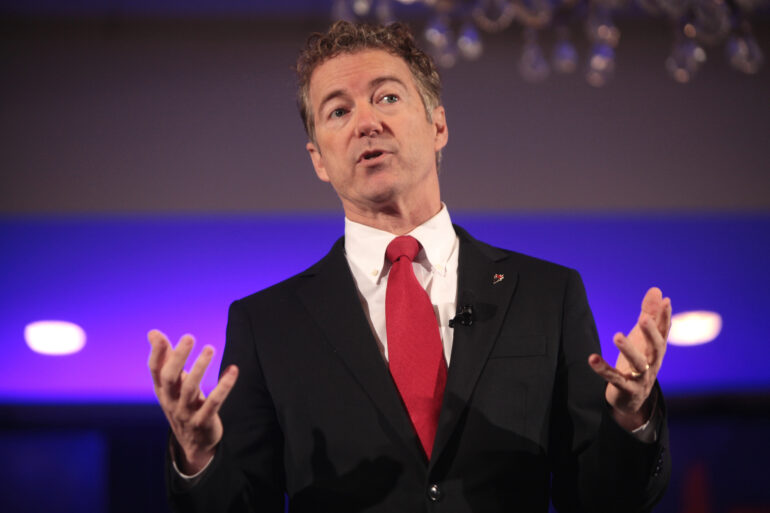

Sen. Rand Paul of Kentucky is raising serious questions about the Trump administration’s reasoning for the ongoing war with Iran, warning that the arguments offered so far have not been particularly persuasive and that prolonged conflict could carry steep political and economic consequences.
Paul made the remarks Tuesday during an interview with Fox Business host Maria Bartiromo in the 8 a.m. hour of the network’s programming. The conversation followed a press conference in which Defense Secretary Pete Hegseth indicated that the day ahead would bring the most intense round of strikes yet in the conflict with Iran.
Bartiromo noted that Hegseth had been providing the public with regular updates about the war effort and asked the Kentucky senator whether the administration had presented a sufficient case for the military campaign.
Paul answered bluntly, saying the justifications offered so far have not been convincing.
“As far as the reasons for the war, there have been many different reasons floated, but none of them, I think, have been very convincing,” Paul said.
The senator proceeded to challenge several of the explanations that have circulated for the conflict.
One argument, Paul said, centers on the idea of freeing the Iranian people from oppression. While he expressed sympathy for those living under authoritarian regimes, he questioned whether military intervention should be the mechanism for achieving that goal.
“I have a great deal of sympathy. I want people to be free around the world,” Paul said. “But if our foreign policy is to free oppressed people, I’m not sure where war would end.”
He pointed out that many parts of the world face similar claims of oppression, including places such as China, Tibet, the Uyghur region, North Korea, and Russia. Pursuing a policy of military intervention wherever oppression exists, Paul suggested, could entangle the United States in a seemingly endless series of conflicts.
“So I think that goal is too grandiose and would perpetually tie us up in war,” he said.
Paul also questioned claims regarding Iran’s nuclear ambitions. According to the senator, warnings that Iran is on the brink of developing nuclear weapons have been repeated for decades.
“You can take clips from the ’90s, all the way through the present, of people arguing that they’re a week away from nuclear weapons,” Paul said.
He added that arguments about Iran’s ballistic missile capabilities have also shifted over time. At one point, Paul noted, it was suggested the missiles could nearly reach the United States. But intelligence assessments later indicated that such a capability might still be six months to a year away if Iran attempted it.
Paul also highlighted what he described as contradictory messaging about Iran’s nuclear capabilities, saying the public has been told at different times that those weapons were destroyed and, alternatively, that they remain close to completion.
“I guess I don’t think the arguments are valid,” Paul said. “War should be the last resort, not the first resort. A war of choice is not my choice.”
The senator also warned that the conflict could carry significant political consequences heading into the 2026 midterm elections.

When Bartiromo asked about the possibility that divisions within the Republican Party could hurt the GOP in the midterms, Paul suggested economic pressures might pose the bigger threat.
“I don’t think split party is the problem,” Paul said. “I think high oil prices will be a problem.”
He added that if rising energy prices combine with continued military operations in Iran, the political fallout could be severe.
“I think if you add in high gas prices, high oil prices, and if we are still bombing Iran with kinetic action — people don’t want to call it war — but if there’s still kinetic action that causes oil to be over $100, I think you’re gonna see a disastrous election,” he said.
Concerns about the political impact of a prolonged conflict have also surfaced among other conservative voices. Human Events senior editor Jack Posobiec warned last week that a drawn-out military campaign aimed at regime change could prove deeply unpopular with voters.
“If this turns into a full-on regime change, forever war kind of prolonged, protracted situation, that’s something that’s going to prove to be very unpopular in this midterm year,” Posobiec said during an interview with Piers Morgan.
He added that younger voters in particular may resist the idea of another extended overseas conflict, describing them as increasingly weary of war.
Meanwhile, Reuters reported Monday that President Donald Trump’s popularity has declined among young men who supported him in the 2024 election, adding another layer of uncertainty as the country moves toward the next national vote.