

President Donald Trump on Friday ordered the federal government to immediately stop using products from artificial intelligence company Anthropic, while the Pentagon moved to formally designate the firm a national security risk — dramatically escalating a standoff over the military’s authority to deploy AI tools without corporate interference.
The twin actions follow a heated dispute between Anthropic and the Defense Department over whether the company could block its AI model, Claude, from being used for domestic mass surveillance or fully autonomous weapons systems under a military contract valued at up to $200 million.
In a fiery Truth Social post, Trump accused the company of attempting to override the Constitution with its own terms.
“The Leftwing nut jobs at Anthropic have made a DISASTROUS MISTAKE trying to STRONG-ARM the Department of War, and force them to obey their Terms of Service instead of our Constitution,” Trump wrote. “Therefore, I am directing EVERY Federal Agency in the United States Government to IMMEDIATELY CEASE all use of Anthropic’s technology. We don’t need it, we don’t want it, and will not do business with them again!”
The president said Anthropic’s technology would be phased out over six months.
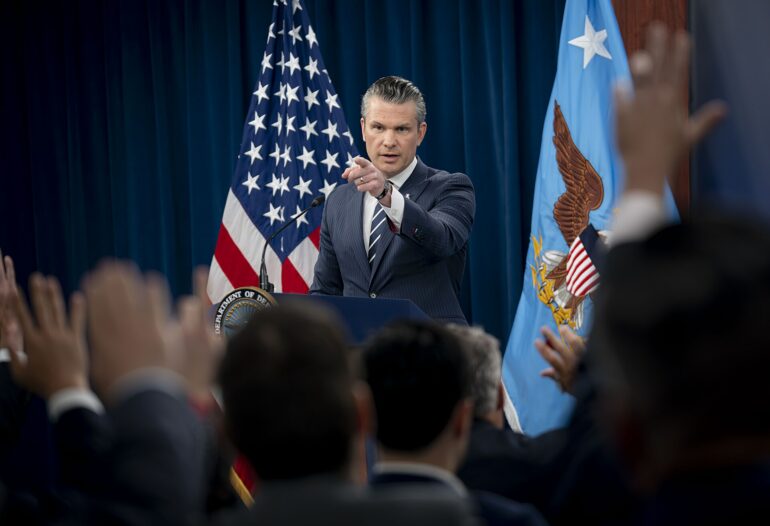
Roughly an hour after Trump’s announcement — and shortly after a Pentagon-imposed deadline passed — Defense Secretary Pete Hegseth declared Anthropic a supply chain risk to national security, blacklisting the company from doing business with the U.S. military or its contractors.
“In conjunction with the President’s directive for the Federal Government to cease all use of Anthropic’s technology, I am directing the Department of War to designate Anthropic a Supply-Chain Risk to National Security,” Hegseth posted on X, using the Pentagon’s “Department of War” rebranding. “Effective immediately, no contractor, supplier, or partner that does business with the United States military may conduct any commercial activity with Anthropic.”
Hegseth said Anthropic would continue providing services for no more than six months to allow for a “seamless transition to a better and more patriotic service.”
Anthropic did not immediately respond to requests for comment.
The Pentagon had given the company until 5:01 p.m. ET Friday to remove restrictions preventing its AI from being used for domestic mass surveillance or fully autonomous weapons. Defense officials have said they do not intend to use AI in those ways, but insist contractors must allow their systems to be used for “all lawful purposes.”
The government had also threatened to invoke the Defense Production Act — a Korean War-era law — to compel cooperation.
Hegseth accused Anthropic of attempting to “seize veto power over the operational decisions of the United States military,” calling its conduct “a master class in arrogance and betrayal.”

“The Department of War must have full, unrestricted access to Anthropic’s models for every LAWFUL purpose in defense of the Republic,” he wrote. “America’s warfighters will never be held hostage by the ideological whims of Big Tech. This decision is final.”
The clash comes as Anthropic, valued at $380 billion, prepares for a public offering. Though its Pentagon contract represents a small fraction of its reported $14 billion in revenue, questions remain about how the confrontation may affect investors and future partnerships.
Anthropic CEO Dario Amodei has defended the company’s stance, arguing that domestic mass surveillance and fully autonomous weapons fall “outside the bounds” of what current AI technology can safely achieve. Pentagon officials, including Undersecretary Emil Michael, countered that existing laws already prohibit such uses and accused Amodei of misrepresenting the department’s position.
“At some level, you have to trust your military to do the right thing,” Michael said.
The standoff highlights a broader battle over whether private tech firms can dictate how the U.S. government deploys critical technologies — or whether national defense decisions ultimately rest with elected leaders and the military chain of command.