
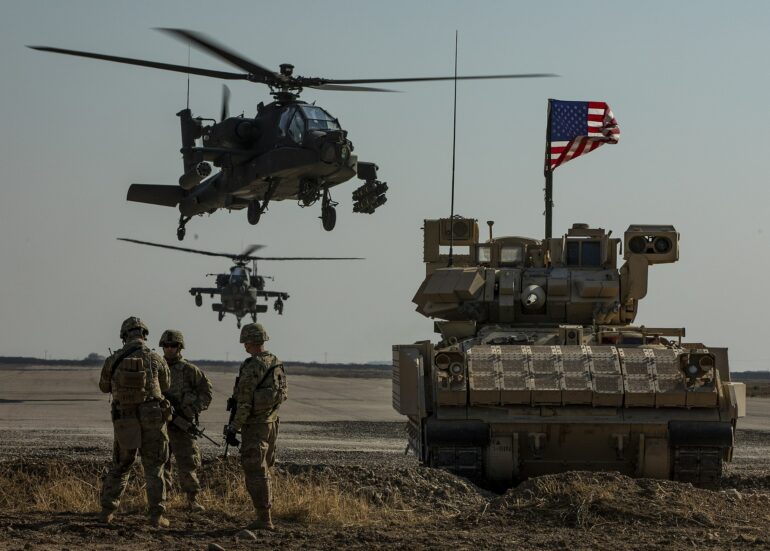

United States forces have withdrawn from a key military installation in southeastern Syria, marking a significant shift in America’s footprint in the war-torn nation where U.S. troops were originally deployed to combat ISIS.
Through coordination between American and Syrian forces, the interim Syrian government assumed control of the al-Tanf base and its surrounding areas, according to a statement from the Syrian Ministry of Defense. Syrian troops have since begun deploying along the country’s borders with Iraq and Jordan, signaling a consolidation of control in a region long considered strategically vital.
U.S. Central Command confirmed the troop drawdown Thursday, describing it as part of a “deliberate and conditions-based transition” carried out under Combined Joint Task Force — Operation Inherent Resolve. The United States has maintained a presence at al-Tanf since 2016 as part of its broader campaign to dismantle ISIS and prevent the terrorist group’s resurgence.
While stepping back from the base, American officials made clear that the mission against ISIS is far from over. “U.S. forces remain poised to respond to any ISIS threats that arise in the region as we support partner-led efforts to prevent the terrorist network’s resurgence,” said Adm. Brad Cooper, commander of U.S. Central Command. He emphasized that “maintaining pressure on ISIS is essential to protecting the U.S. homeland and strengthening regional security.”
The withdrawal comes amid shifting dynamics inside Syria, where President Ahmed al-Sharaa is seeking to reassert control over territory fractured during years of brutal civil war. Last month, al-Sharaa’s forces launched an offensive in northeastern Syria targeting Kurdish-led militias known as the Syrian Democratic Forces — a group that has long received backing from the United States. The offensive resulted in government forces gaining control over oil fields in the region.
The change in posture follows remarks last month from President Trump’s special envoy to Syria, Tom Barrack, who indicated that the United States would pivot toward working with al-Sharaa’s forces on counterterrorism operations. The move signals a recalibration of partnerships on the ground while keeping the focus squarely on defeating ISIS.

American troop levels in Syria have fluctuated in recent years. Following Hamas’s October 7, 2023, attack on southern Israel, U.S. forces in Syria increased to more than 2,000 personnel. However, citing gains made against ISIS, the Pentagon began withdrawing approximately 600 troops last year. The drawdown at al-Tanf is the latest development in that broader adjustment.
Despite the withdrawal from this key base, the United States continues to maintain a military presence at other locations within Syria. Centcom reports that U.S. forces have recently struck more than 100 ISIS targets using over 350 precision munitions. Those operations have resulted in the capture or killing of more than 50 ISIS terrorists, underscoring Washington’s ongoing commitment to keeping the extremist group on the defensive.
As the situation in Syria continues to evolve, U.S. officials stress that protecting the American homeland and preventing ISIS from regaining a foothold remain top priorities. The withdrawal from al-Tanf may mark the end of one chapter in America’s military engagement there, but the fight against ISIS — and the strategic stakes in the region — remain very much in focus.