

President Trump is laying out a blunt game plan for what he’ll do if Democrats take back Capitol Hill in Tuesday’s midterm elections: block their agenda one bill at a time.
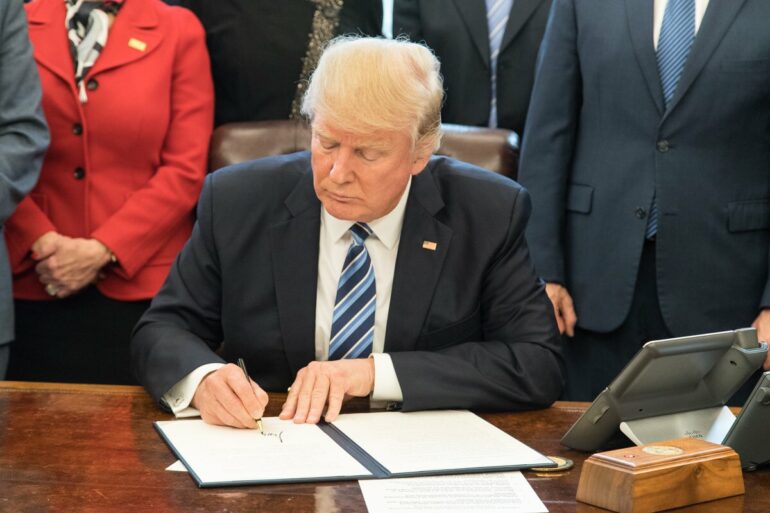
Speaking with the New York Post’s Miranda Devine on the “Pod Force One” podcast, set to air Monday, the president said that if Republicans lose the House and Senate, he would “become Mr. Veto.”
“I’m not going to let them through,” Trump said.
The president described a deliberate, patient approach. Democrats would send legislation to his desk, he would reject it, and after a month or two of vetoes, he predicted, they would eventually come to the table ready to make deals.
The remarks are a rare acknowledgment from the president that his party could come up short on Election Day. Trump has been crisscrossing the country in the final stretch of the campaign, rallying voters in traditionally Republican territory where GOP candidates face headwinds tied to cost-of-living concerns and the war in Iran.
The forecasts aren’t encouraging for Republicans. Decision Desk HQ projects Democrats will likely win the House, putting their chances at 83 percent compared with 17 percent for the GOP. In the Senate, Democrats are given a 63 percent chance of regaining control, with Republicans at 37 percent.
Still, the math of the veto strongly favors the White House. Overriding a presidential veto requires a two-thirds majority in both the House and the Senate, a threshold far beyond what even a strong Democratic showing would likely deliver.
Trump is no stranger to divided government. He enjoyed a Republican-controlled Congress during the first two years of each of his terms, but Democrats took control of the House in 2019. During that stretch, he threatened to veto several high-profile bills, including a Senate resolution aimed at blocking his national emergency declaration to fund construction of a wall along the southern border. He followed through, issuing the first veto of his presidency in that fight.
In 2020, he again reached for the veto pen to reject a war powers resolution related to Iran, calling it an insulting measure that Democrats introduced to divide Republicans ahead of that year’s election.

All told, Trump issued ten vetoes during his first term. Congress overrode just one: the annual defense policy bill, at the start of 2021.
Democrats have also struggled to muster the two-thirds majority needed to override the president’s more recent vetoes, with some on the left accusing him of rejecting bills to settle political scores.
If Democrats do win one or both chambers, Trump would still hold the veto as one of the central tools of the presidency, along with executive authority he could use to advance parts of his agenda without Congress.