
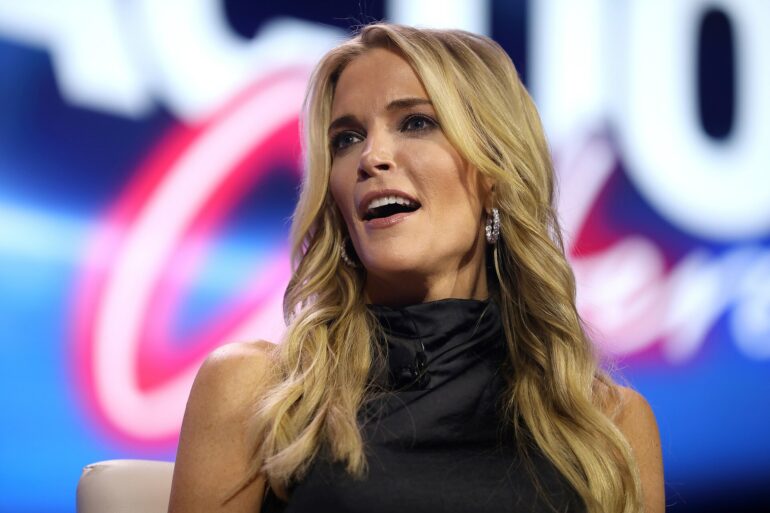

SiriusXM host and political commentator Megyn Kelly delivered a sharp rebuke of President Donald Trump this week, accusing him of being misled into what she described as a chaotic and ill-defined conflict with Iran.
Her criticism followed revelations from a detailed report by Maggie Haberman and Jonathan Swan, who are preparing to release their forthcoming book Regime Change: Inside the Imperial Presidency of Donald Trump. According to their reporting, key national security officials expressed skepticism about intelligence presented to the president by Israeli Prime Minister Benjamin Netanyahu in the lead-up to the conflict.
The account describes a meeting involving CIA Director John Ratcliffe, Joint Chiefs Chairman Dan Caine, and Secretary of State Marco Rubio, during which the intelligence cited by Netanyahu was reportedly dismissed by top U.S. officials.
Appearing on Piers Morgan Uncensored, Kelly did not hold back. She questioned how Trump, at this stage in his life and presidency, could have accepted Netanyahu’s claims so readily—especially, she noted, when other leaders had resisted similar pressure in the past.
Kelly pointed to what she described as a troubling scene in the White House Situation Room, where she said Netanyahu appeared on equal footing with the American president. In her telling, Trump’s willingness to entertain the Israeli leader’s arguments raised serious concerns about judgment and leadership at a critical moment.
More significantly, Kelly emphasized that Trump was allegedly warned by his own senior advisers shortly after the meeting. She cited guidance from top officials—including military and diplomatic leadership—who reportedly cautioned that the objectives being discussed were unrealistic and based on flawed assumptions.
According to Kelly, even limited military gains—such as targeting Iran’s leadership or degrading its missile capabilities—fell far short of the sweeping goals that were publicly suggested. She argued that claims of achieving regime change were unfounded, asserting that Iran’s ruling structure remained intact, albeit with different figures in power.
Kelly further contended that the situation may have worsened. She suggested that the Iranian Revolutionary Guard Corps now appears to hold greater influence and described the broader regional outcome as unstable. In her view, Iran has strengthened its economic position, maintained control over key waterways, and is now pressing for the removal of sanctions.

The commentator also criticized what she characterized as a sudden shift in Trump’s stance. She referenced a reported 10-point plan that Trump initially rejected before later embracing, framing the reversal as an effort to step back from earlier threats without losing face.
Ultimately, Kelly placed responsibility not only on external voices like Netanyahu but also on figures within Trump’s political orbit, including Sen. Lindsey Graham and commentator Mark Levin. Still, she made clear that the final decision rested with the president himself.
Her conclusion was blunt: whatever the influences, Trump allowed himself to be drawn into what she described as an unnecessary and misguided conflict—raising broader questions about how the United States entered yet another costly confrontation abroad.