
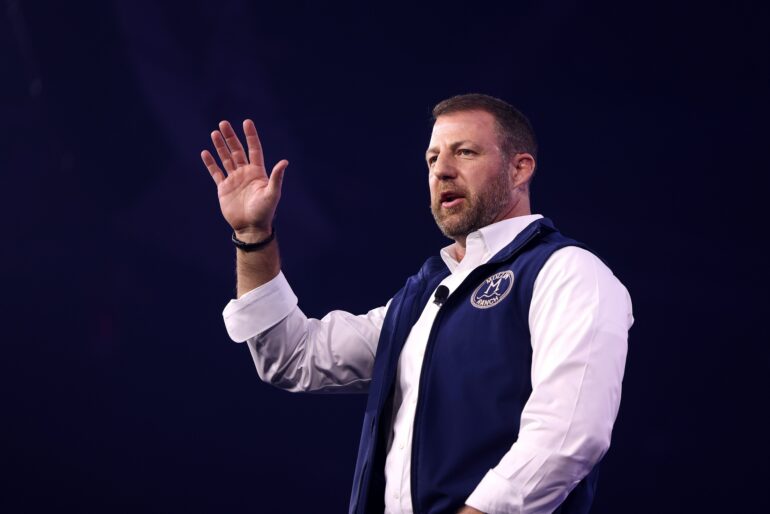

The Senate moved forward Monday night with the confirmation of President Donald Trump’s nominee to lead the Department of Homeland Security, placing Republican Oklahoma Sen. Markwayne Mullin at the helm even as the agency remains mired in a partial shutdown now stretching into its 38th day.
Mullin’s confirmation came at a tense moment in Washington, with negotiations between Republicans and Democrats still stalled over proposed changes to DHS law enforcement policies. In the meantime, the administration has taken steps to manage the strain on federal operations, including deploying Immigration and Customs Enforcement agents to airports to assist with security as thousands of Transportation Security Administration employees continue working without pay.
The Senate ultimately voted 54-45 to confirm Mullin, with two Democrats — Sens. John Fetterman of Pennsylvania and Martin Heinrich of New Mexico — crossing party lines to support the nomination. Republican Sen. Rand Paul of Kentucky broke with his party, voting against Mullin alongside the rest of the Democratic caucus.
Senate Majority Leader John Thune praised Mullin on the Senate floor ahead of the vote, calling him a trusted colleague and expressing confidence in his leadership. Thune acknowledged the loss to the Senate but framed Mullin’s confirmation as a gain for the country, highlighting his service and signaling optimism about his tenure at DHS.
During his confirmation process, Mullin signaled a willingness to address some Democratic concerns, marking a notable shift from the approach of former DHS Secretary Kristi Noem. He pledged to enforce requirements for federal agents to obtain judicial warrants before entering homes and to limit enforcement activity at sensitive locations such as polling sites. At the same time, Mullin emphasized that law enforcement would retain the authority to act decisively in urgent situations, including pursuing suspects into homes or responding to active threats.
Supporters argued that Mullin’s approach strikes a balance between upholding the law and ensuring public safety. Senate Majority Whip John Barrasso said Mullin had laid out a clear vision centered on protecting the American people and maintaining a consistent, visible presence.
Behind the scenes, efforts to break the shutdown impasse have continued. Trump’s border czar, Tom Homan, has met with a bipartisan group of senators in recent days to explore potential compromises. According to Republican Sen. John Hoeven of North Dakota, those talks have produced signs of progress, with the White House putting forward what he described as serious offers.
Among the proposals under discussion are expanded use of body cameras for ICE and Customs and Border Protection agents, increased congressional oversight of DHS facilities, clearer identification for officers and explicit protections against the detention or deportation of U.S. citizens. Hoeven suggested that walking away from such proposals would mean abandoning what he characterized as common-sense measures.

Still, a broader agreement remains elusive. A proposal floated by White House aides and Senate leadership to fund most DHS operations while addressing ICE funding separately failed to gain traction with the president. Trump has insisted that any deal must include sufficient support for the SAVE America Act, which faces a 60-vote threshold in the Senate.
A group of Republican senators, including Katie Britt, Steve Daines, Lindsey Graham and Bernie Moreno, traveled to the White House on Monday in an effort to revive negotiations. Their visit underscored the urgency of resolving the funding standoff, which has left critical national security functions operating under strain.
As debate over the SAVE America Act continues, the confirmation of Mullin adds new leadership at DHS — but does little, at least for now, to resolve the broader deadlock. With federal workers still caught in the middle and policymakers entrenched in their positions, the path forward remains uncertain, a reminder that even in matters of national security, prolonged political battles can carry real and lasting consequences.
[READ MORE: Shannon Bream’s Latest Bestseller Highlights Faith, Resilience in Uncertain Times]