
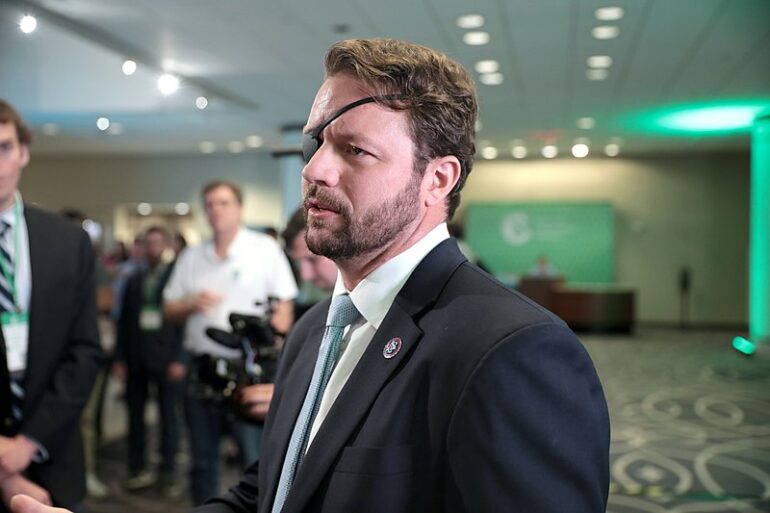

Former Rep. Dan Crenshaw (R-Texas) is pointing to what he describes as a flood of misinformation and “clickbait politics” as the driving force behind his primary defeat to state Rep. Steve Toth, arguing that false narratives about stock trading ultimately overshadowed reality in the minds of voters.
Speaking candidly after the loss, Crenshaw said many voters were led to believe he had profited heavily from insider trading—an accusation he flatly rejected. According to Crenshaw, the claims bore little resemblance to his actual financial record.
“A large part of this election was about the power of clickbait. Memes became truth,” Crenshaw said, lamenting what he described as a lack of discernment among voters. “Too many people are not discerning through the clickbait.”
He went further, explaining that some voters entered the ballot box convinced he had made millions through improper stock activity. “Even though I haven’t made a trade in three years,” Crenshaw said, adding that his total earnings from the market over seven years in office were under $46,000. “The truth didn’t matter to people.”
The controversy comes as House Republicans continue pushing legislation aimed at curbing stock trading among members of Congress—an issue that has drawn bipartisan attention and the backing of the president. In January, lawmakers advanced a proposal led by Rep. Bryan Steil (R-Wis.) that would allow elected officials and their families to retain existing stock holdings but prohibit future purchases.
Despite the momentum, the bill has yet to receive a full House vote. Democrats, meanwhile, are expected to oppose the measure in its current form, citing the absence of restrictions on stock trading by the president, vice president, and their families.
For Crenshaw, the broader issue extends beyond one race or one bill. He argued that persistent online rumors and conspiracy-driven narratives—particularly claims that members of Congress routinely exploit non-public information—played a decisive role in shaping voter perceptions.
“Dozens of online smears and conspiracies… people were going into the voting booth actually believing,” Crenshaw said during a Sunday appearance on CBS’ Face the Nation. He noted that even repeated efforts to debunk those claims failed to break through.
Crenshaw also pointed to low voter turnout in Republican primaries, suggesting that a relatively small and highly influenced segment of the electorate can have an outsized impact. In that environment, he warned, emotionally charged misinformation can spread faster than facts—especially at a time when Americans are already navigating uncertainty on multiple fronts.
While he stopped short of drawing a direct line, the backdrop of ongoing international tensions and conflict has only heightened public skepticism toward institutions, including government officials. In such a climate, trust becomes harder to maintain—and easier to erode.

Crenshaw additionally accused Democrats of amplifying the misleading narratives, calling it a cautionary tale not just for candidates, but for voters themselves.
“The lesson to be learned is… are you going to believe everything that you read online?” he asked, framing the issue as a broader test of civic responsibility in an era where information—and misinformation—travels instantly.
His warning underscores a growing concern within conservative circles: that the battle for political power is increasingly being fought not just on policy or principle, but in the chaotic and often unreliable arena of digital media—where truth can become just another casualty.