
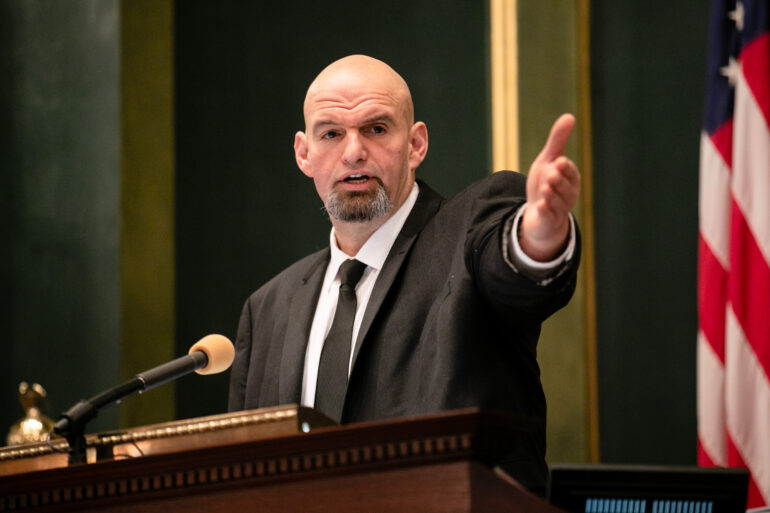

Sen. John Fetterman (D-Pa.), often viewed as one of the more centrist voices in his party, now reportedly says he will not support the House-passed Safeguard American Voter Eligibility (SAVE America) Act in its current form, even as he pushes back against what he sees as exaggerated rhetoric from fellow Democrats about the legislation.
Speaking with CBS’s The Takeout with Major Garrett, Fetterman made clear that while he disagrees with how some Democrats are framing the bill, he still plans to vote against it when it comes before the Senate.
“I don’t support … in its current state to vote SAVE America,” Fetterman said. At the same time, he criticized President Trump’s repeated attacks on mail-in voting, arguing that the system has proven to be reliable.
“And the president is constantly critical on mail-in voting, and that’s ridiculous. It’s safe,” Fetterman added.
The SAVE America Act would require individuals to provide documented proof of citizenship when registering to vote. It would also require voters submitting absentee ballots by mail to provide photocopies of identification documents as part of the process.
Supporters of the legislation say the requirements are designed to strengthen election security and restore confidence in the voting system. But critics argue the changes could make it harder for some Americans to participate in elections.
Fetterman sought to draw a distinction between those concerns and the language some Democrats have used to describe the bill. Several Democratic lawmakers have likened the legislation to “Jim Crow 2.0,” rhetoric that Fetterman has previously suggested goes too far.
While opposing the bill, the Pennsylvania senator emphasized that mail-in voting has been successfully implemented in a number of Republican-led states.
“Some of the best examples in the country are from red states like Ohio and Florida,” he said.
Those states require voters to provide identifying information when casting ballots by mail. In Ohio, voters must provide a driver’s license number, a state ID card number, or the last four digits of a Social Security number. Florida uses a similar system when voters request absentee ballots.
Fetterman said his own experience in Pennsylvania gives him a unique perspective on how the debate around mail voting has evolved.
“I have a unique perspective on that … in 2019 as I was lieutenant governor, the Republicans in Pennsylvania pushed for mail-in voting,” he said.
According to Fetterman, the measure was supported unanimously by Republican lawmakers at the time.
“They forced us to give up this straight party line, that was one or two states in the country at that time,” he explained. “And then immediately the president decided that’s wrong, and now they had to walk back and explain why unanimously every single Republican voted for that in 2019.”

The SAVE America Act is expected to reach the Senate floor soon. Senate Majority Leader John Thune (R-S.D.) is anticipated to schedule a vote as early as next week.
With Fetterman publicly stating his opposition, Democrats appear unified in their stance against the measure. If all Democrats vote no, the bill will face a steep uphill climb in the Senate.
President Trump has urged Senate Republicans to consider reinterpreting the chamber’s filibuster rules in order to force Democrats to conduct a “talking filibuster.” Under that approach, senators seeking to block the bill would have to remain on the Senate floor and continuously speak to hold up the legislation.
Supporters of the idea believe the physical and political strain of maintaining a prolonged debate might eventually weaken opposition and allow the bill to move forward.
Without such a change, Democrats could block the measure through the traditional Senate process. Ending debate on the bill would require 60 votes, a threshold that is difficult to reach in the closely divided chamber.
For now, the debate surrounding the SAVE America Act reflects the broader struggle over election policy in Washington — a fight shaped by competing concerns about ballot security, voter access, and the political consequences of changing the rules governing how Americans cast their votes.
[READ MORE: Driver Detained After Van Crashes Through Barricade Near White House]