
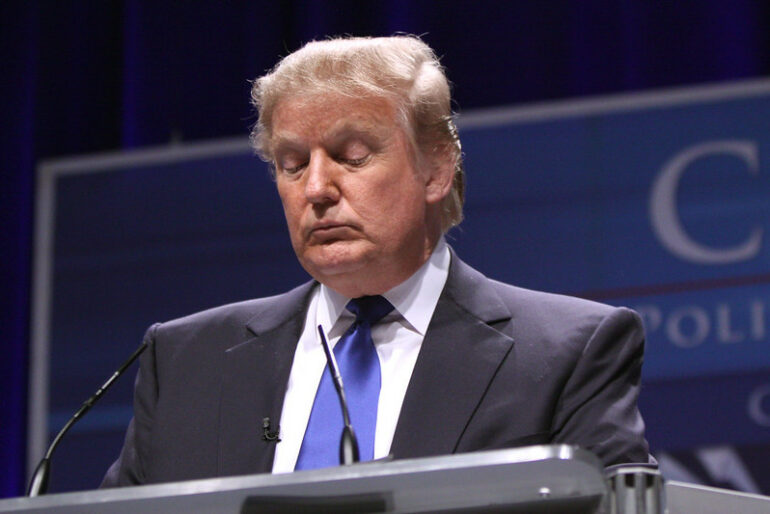

President Donald Trump said Thursday that the United States will “very soon” escalate its efforts against alleged Venezuelan drug traffickers by targeting land-based smuggling routes, following weeks of U.S. military strikes against boats operating in Caribbean waters. Speaking to military personnel in a Thanksgiving address, Trump praised ongoing missions and warned traffickers that the U.S. is prepared to intensify its campaign.
“In recent weeks, you’ve been working to deter Venezuelan drug traffickers, of which there are many,” Trump said. He noted that smugglers were already shifting tactics in response to maritime interdictions. “You probably noticed that people aren’t wanting to be delivering by sea anymore,” he said, adding, “We’ll be starting to stop them by land also.”
Trump emphasized that the transition to land-based enforcement is imminent. “The land is easier, but that’s going to start very soon. We warn them: Stop sending poison to our country.”
The president’s remarks come after the U.S. military positioned the USS Gerald R. Ford, one of the Navy’s most powerful carriers, in the region earlier this month. The deployment is meant to strengthen American capabilities under U.S. Southern Command as it conducts counter-narcotics operations.
“The enhanced U.S. force presence in the USSOUTHCOM AOR will bolster U.S. capacity to detect, monitor, and disrupt illicit actors and activities that compromise the safety and prosperity of the United States homeland and our security in the Western Hemisphere,” Pentagon spokesperson Sean Parnell said in a statement. He added that the forces “will enhance and augment existing capabilities to disrupt narcotics trafficking and degrade and dismantle Transnational Criminal Organizations.”
The Trump administration has maintained its goal of blocking illegal narcotics from entering the United States, especially as fentanyl and cocaine trafficking continue to contribute to thousands of American deaths each year. But the recent strikes on boats in Caribbean waters have generated criticism from some foreign officials and U.S. lawmakers, as reports surfaced claiming that individuals killed in the operations had no proven involvement in drug trafficking.
Trump has long characterized Venezuelan President Nicolás Maduro as an “illegitimate leader” associated with trafficking networks in the region. Maduro denies the accusations. But the tension has fueled broader geopolitical debate over U.S. strategy in Latin America.
Colombian President Gustavo Petro, who was recently sanctioned by the Trump administration, questioned Trump’s motives in an interview published Wednesday. “Oil is at the heart of the matter,” Petro told CNN. “So, that’s a negotiation about oil. I believe that is [President] Trump’s logic. He’s not thinking about the democratization of Venezuela, let alone the narco-trafficking.”

While Venezuela is not a major producer of fentanyl, cocaine flows remain a central concern. The Drug Enforcement Administration estimated in 2020 that roughly 74 percent of the cocaine entering the U.S. traveled through the Pacific. According to the State Department, most cocaine originating from Venezuela was shipped to Europe or Brazil.
The New York Times reported earlier this month that U.S. military officers confirmed no cocaine had been found on the vessels struck by American forces. Even so, Trump has made clear that land routes are now the next target in his campaign, signaling that the administration will continue to expand its efforts against trafficking networks tied to Venezuela.
[READ MORE: Newsom’s Housing Promises Fall Flat as California Crisis Deepens]