
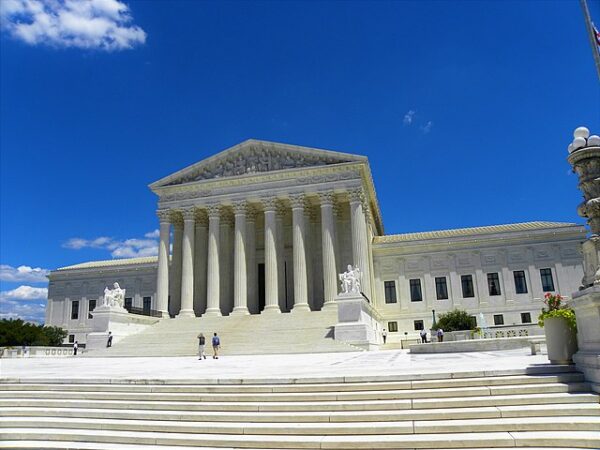

President Donald Trump announced Wednesday that he intends to ask the U.S. Supreme Court to rehear its recent decision striking down his executive order restricting birthright citizenship, calling the ruling a threat to the country and urging the justices to reconsider.
In a post on Truth Social, Trump sharply criticized the court’s decision and vowed to move quickly with a rehearing request.
“I will be asking for a Rehearing by the United States Supreme Court, IMMEDIATELY,” Trump wrote. “This miscarriage of justice will destroy America if they don’t change their absolutely insane decision.”
The Supreme Court issued the ruling on the final day of its term last week, invalidating Trump’s executive order, which sought to limit automatic citizenship for children born in the United States. Under the order, a child born on U.S. soil would only receive automatic U.S. citizenship if at least one parent was either a U.S. citizen or a lawful permanent resident.
The court ruled that the order conflicted with the protections provided by the 14th Amendment, which the majority concluded guarantees citizenship to nearly all children born in the United States.
Chief Justice John Roberts authored the majority opinion and was joined by conservative Justice Amy Coney Barrett as well as liberal Justices Sonia Sotomayor, Elena Kagan and Ketanji Brown Jackson.
In the court’s opinion, Roberts wrote that citizenship has long represented a fundamental constitutional guarantee.
“Citizenship, then and now, was the right to have rights — to freely participate in our political community,” Roberts wrote in the court’s 26-page decision. “The Framers of the Fourteenth Amendment extended that promise to ‘every free-born person in this land.’”
Justice Brett Kavanaugh took a different position on part of the case. While he disagreed with the majority’s conclusion regarding whether Trump’s executive order violated the 14th Amendment, he nevertheless voted to block enforcement of the policy under a federal law that mirrors the amendment’s language.
Three conservative justices dissented from the ruling.
Justices Clarence Thomas, Samuel Alito and Neil Gorsuch argued that the majority reached the wrong conclusion. In his 39-page dissenting opinion, Alito wrote that the Supreme Court “made a serious mistake” by upholding birthright citizenship.
Although parties that lose before the Supreme Court are permitted to seek a rehearing, such requests are rarely granted.
Steve Vladeck, a professor at the Georgetown University Law Center, noted in 2024 that the Supreme Court has not agreed to rehear a ruling in a fully argued case since 1965. He also wrote that the court has not granted a plenary rehearing since 1956.

Writing on his “One First” Substack, Vladeck said the primary significance of rehearing petitions today is generally procedural rather than substantive.
“Instead, the principal significance of rehearing petitions with respect to merits rulings today is how they affect the timing of the remand to lower courts,” he wrote.
Federal law requires parties seeking a rehearing to file their petition within 25 days after the Supreme Court enters its judgment, unless the court or an individual justice modifies that deadline.
The law also specifies that the filing period cannot be extended for petitions seeking rehearing after the Supreme Court denies a petition for a writ of certiorari or an extraordinary writ.
[READ MORE: Florida Officials Charged in Alleged Fake Voter Guide Scheme Ahead of 2024 Primary]