
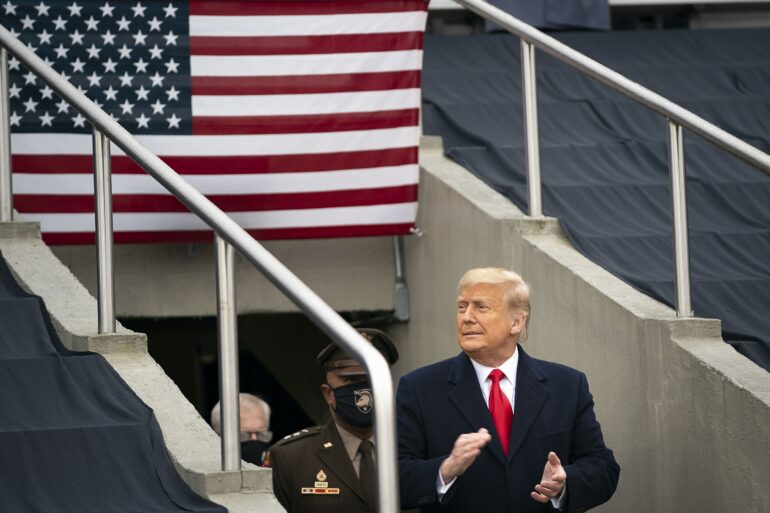

President Donald Trump reportedly took to social media to celebrate what he framed as a major breakthrough in the Middle East, after Iran that the strategically vital Strait of Hormuz would remain open during an ongoing ceasefire period tied to an agreement between Israel and Lebanon.
The announcement came from Iranian Foreign Minister Seyed Abbas Araghchi, who stated that, “in line with the ceasefire in Lebanon,” commercial vessels would be allowed to pass freely through the strait for the duration of the ceasefire.
According to Araghchi, the move would follow coordinated maritime routes already established by Iran’s Ports and Maritime Organisation, signaling at least a temporary easing of tensions in one of the world’s most critical energy corridors.
The Strait of Hormuz, a key artery for global oil shipments, has long been a flashpoint in regional conflicts. Its reopening, even under limited conditions, was quickly seen as a positive signal by markets and policymakers alike.
Trump, posting on his Truth Social platform, wasted little time highlighting the development. In a characteristically emphatic message, the president declared that “the Strait of Iran is fully open and ready for full passage,” offering a brief but enthusiastic “thank you” in response to the announcement.
The phrasing underscored Trump’s tendency to frame geopolitical developments in stark, declarative terms, even as the situation on the ground remains complex.
But the celebration came with a notable caveat. Minutes later, Trump followed up with another statement clarifying that the United States’ naval blockade in the region would remain firmly in place—at least for now.
While acknowledging that the strait is “completely open and ready for business,” Trump emphasized that U.S. forces would continue enforcing a blockade specifically targeting Iran until what he described as a broader “transaction” with the country is fully completed.
According to Trump, that process may not take long, noting that “most of the points are already negotiated.” The remark hinted at ongoing diplomatic efforts, though details of any agreement were not disclosed in the statements.
The dual messaging—celebrating open passage while maintaining a military posture—reflects the balancing act at the heart of current U.S. policy.

On one hand, the reopening of the strait offers a measure of stability in a region often defined by volatility. On the other, the continued blockade signals that tensions have not fully subsided, and that enforcement measures remain central to the administration’s approach.
Markets responded swiftly to the news. Oil prices dropped by more than 10 percent, while stocks surged, according to the Associated Press, suggesting that investors welcomed the prospect of fewer disruptions to global energy flows. For American consumers and businesses alike, the price movement may offer short-term relief after periods of uncertainty.
Still, the broader implications remain unclear. While the reopening of a major shipping lane is undeniably significant, the persistence of military enforcement raises questions about how durable the current calm may be. Moments like these often illustrate how quickly geopolitical gains can hinge on fragile arrangements, where diplomacy and force continue to operate side by side.
For now, the administration is touting progress. But even amid the optimism, the presence of a blockade serves as a quiet reminder that peace, particularly in such a volatile region, rarely comes without conditions.
[READ MORE: Cruz Turns Down Supreme Court Talk, Signals Preference for Political Arena]