
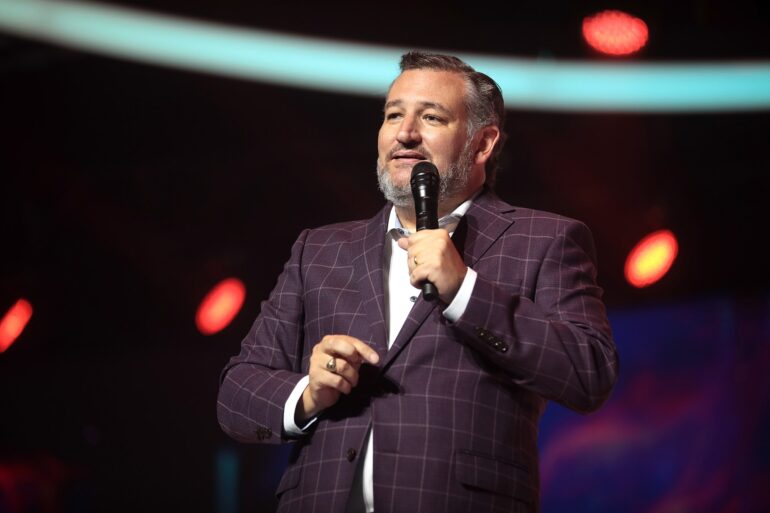

Sen. Ted Cruz reportedly made clear this week that while he has been seriously considered for a seat on the nation’s highest court, he has no intention of trading the bruising world of politics for the quieter confines of the judiciary.
Speaking during a Wall Street Journal Opinion Live interview, Cruz revealed that Donald Trump approached him multiple times during his first administration about filling potential Supreme Court vacancies. Each time, Cruz said, he declined.
“In the first Trump term, the president spoke to me seriously about all three vacancies, and three times I said no, because I don’t want to be out of the arena of the political battle,” Cruz explained. For the Texas Republican, the decision was less about qualifications and more about where he believes he can have the greatest impact.
Cruz argued that the real fight lies not in interpreting the law from the bench, but in shaping it through legislation. He pointed to ongoing policy battles in Congress as evidence that the stakes remain high and unresolved. “There’s too much need there,” he said, emphasizing his belief that elected office is where consequential decisions are forged.
The comments come as Trump considers the possibility of new openings on the Supreme Court during his second term, particularly if Justices Clarence Thomas or Samuel Alito decide to step down. Such speculation has already reignited discussions about who might shape the next chapter of the court.
Trump has spoken favorably about Cruz in the past, even suggesting that a nomination could draw rare bipartisan support in the Senate. At a February event in Corpus Christi, Texas, Trump remarked that Cruz might be the kind of nominee capable of uniting both parties, adding that some lawmakers might even welcome his departure from Congress.
Despite the president’s praise, Cruz remains unmoved. His reasoning reflects a broader philosophical divide between the judiciary and the legislative branch. While judges are expected to remain detached from political disputes, Cruz made it clear that detachment is precisely what he wants to avoid.
“I don’t want to be a judge,” he said. “A principled federal judge stays out of policy fights and stays out of political fights. If I were a judge, I would do that. I don’t want to do that.”

Instead, Cruz pointed to what he sees as tangible policy victories achieved through legislative persistence. He highlighted measures like school choice initiatives and so-called “Trump accounts” as examples of outcomes that required direct political engagement—efforts he believes would not have materialized from the bench.
At a time when the Supreme Court has delivered key wins for conservatives, it has also dealt setbacks to parts of Trump’s policy agenda. Legal challenges to issues like tariffs and birthright citizenship have underscored the limits of judicial alignment, even with a 6-3 conservative majority. For some, it’s a reminder that the courtroom can be as unpredictable as any political battlefield—and often just as consequential.
Cruz, who brings a deep legal résumé that includes a Harvard Law degree and service as Texas solicitor general, is no stranger to the legal world. Yet he insists his role is better suited to shaping the law rather than interpreting it.
Ultimately, Cruz framed his decision as one of purpose. While he supports the nomination and confirmation of what he called “principled constitutionalist judges,” he believes his place is elsewhere—squarely in the middle of the political fight, where laws are written, debated, and contested in real time.