
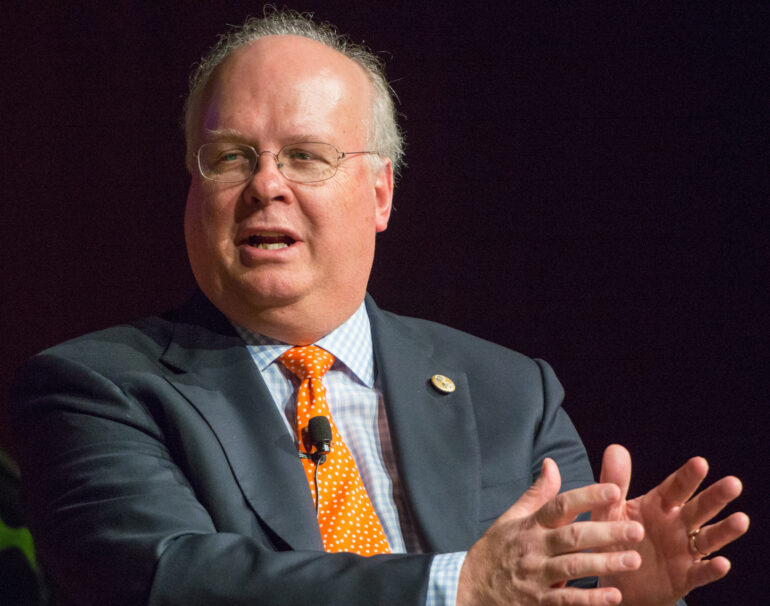

Legendary Republican strategist Karl Rove is sounding the alarm for Democrats who may be eyeing the White House in 2028, arguing that California Governor Gavin Newsom’s record could prove to be a major liability on the national stage.
Writing in a new column for The Wall Street Journal, Rove pointed to remarks Newsom made at last week’s Munich Security Conference, where the governor told world leaders that “Donald Trump is temporary. He’ll be gone in three years.” Rove acknowledged that President Trump will not be in office after Jan. 20, 2029, but emphasized that the impact of his presidency will endure well beyond his departure from the Oval Office.
However, Rove argued that Newsom faces a different and more immediate challenge. While historians will ultimately render their verdict on Trump’s presidency, Newsom’s record in Sacramento, he wrote, will be judged by voters in real time if the governor seeks to succeed Trump. That distinction, Rove suggested, gives Newsom “an awful lot to overcome.”
According to Rove, California under Newsom has struggled across a range of key metrics. The state has experienced a population decline and a shrinking congressional delegation, developments that signal deeper structural issues. Rove also highlighted economic and quality-of-life rankings that paint a troubling picture for the Golden State.
Citing U.S. News & World Report, Rove noted that California ranks No. 32 on its economy, 42 on fiscal stability, 45 on growth, 46 on employment, and dead last for opportunity. He also pointed to the state’s standings in other critical areas: 36th in Pre-K-12 education and 43rd on public safety.
Housing costs, long a flashpoint in California politics, received particular attention. Using Redfin data, Forbes reported in September that the median home price in California stood at $906,500—nearly double the national median of $462,206. Only Hawaii and the District of Columbia were more expensive. Rove suggested that such staggering costs help explain why the state’s population growth has stalled, as families and businesses increasingly look elsewhere.
The broader implication of Rove’s analysis is clear: glossy rhetoric and international appearances may not offset hard numbers at home. In his column, he briefly criticized Illinois Governor JB Pritzker as well, implying that both Democratic governors may face similar hurdles if they pursue national ambitions.
“Mr. Newsom has great hair and Mr. Pritzker a vast fortune,” Rove wrote, but he argued that neither personal image nor wealth will matter as much as governing records. In his view, neither man can credibly claim a strong record of economic achievement in his state.

Rove concluded that while such shortcomings might not pose a significant problem in a Democratic primary, they are likely to carry far greater weight in a general election. Come November 2028, he suggested, voters will be less interested in style and more focused on substance—and on whether a candidate’s record demonstrates real economic success.
If Newsom intends to mount a serious bid for the presidency, Rove’s message is blunt: the numbers out of California may prove to be his toughest opponent.
[READ MORE: Report Raises Questions Surrounding Alleged Affair Between Texas Congressman and Late Aide]