
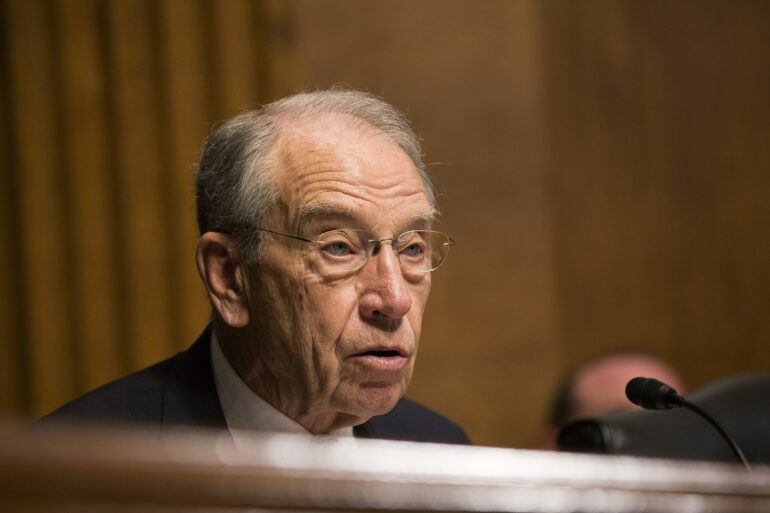

Republican Sen. Chuck Grassley of Iowa found himself facing criticism this week after a letter he sent to a constituent was interpreted by some as pushing back against federal voter ID legislation, reigniting debate inside the GOP over how best to secure U.S. elections.
Grassley, the longtime chairman of the Senate Judiciary Committee, responded to a general inquiry about election integrity in a Jan. 20 letter that later circulated online. In the correspondence, Grassley emphasized his belief that states, not Washington, D.C., should control how elections are run.
“I do not believe that Iowa and other states need politicians in Washington D.C. dictating and controlling how states run their elections,” Grassley wrote. At the same time, he expressed support for voter ID requirements, saying he believes every fraudulent vote dilutes the votes of legitimate voters.
Grassley explained that states are responsible for crafting their own election laws and noted that state requirements for voter identification vary beyond the minimum standards set by federal law. Although the constituent’s name was redacted, the letter addressed concerns about election integrity and state authority.
Once the letter began circulating on social media Tuesday, some critics interpreted Grassley’s comments as opposition to the Safeguard American Voter Eligibility Act, known as the SAVE Act. The bill would require states to verify citizenship before registering someone to vote in federal elections and mandate the removal of non-citizens from voter rolls.
Grassley moved quickly to push back on that interpretation. In a post on X Wednesday, he said he is not opposed to the SAVE Act and stressed his record on election security. He wrote that he has been fighting alongside Iowa Secretary of State Paul Pate to hold the Biden administration accountable for what he described as withholding immigration and citizenship voter data during the 2024 election. Grassley emphasized that elections must be secure and that only citizens should be voting.
The controversy drew a response from Republican Sen. Mike Lee of Utah, the sponsor of the SAVE Act and a fellow member of the Judiciary Committee. Lee argued that federal law itself is part of the problem, pointing to the National Voter Registration Act, which courts have interpreted as limiting states’ ability to require proof of citizenship. He said the SAVE Act is designed to fix that issue and argued that federalism cannot be used as a shield when federal law is causing the harm.
Lee expanded on that argument in additional posts, saying constitutional damage can occur not only when Congress oversteps but also when it fails to act where federal intervention is necessary. One of Lee’s posts was later shared by President Donald Trump on Truth Social, giving the exchange added visibility.
Grassley, for his part, reiterated in the letter that he has opposed past Democratic-led efforts to federalize elections. He cited his opposition to the For the People Act and the Freedom to Vote Act, legislation that would have expanded automatic voter registration, broadened mail-in voting, and allowed documents like utility bills or bank statements to serve as valid identification for federal elections.
After Grassley clarified that he does not oppose the SAVE Act, Lee told the Daily Caller that he was grateful for Grassley’s support. Lee said he looks forward to working with Grassley to pass the bill and send it to President Trump’s desk, stressing the importance of protecting the right of American citizens, and only American citizens, to vote.
The House passed the SAVE Act last year, but the Senate has not yet scheduled a vote, leaving the bill’s future uncertain. Grassley’s office confirmed that the letter circulating online is authentic but did not say whether the senator plans to issue a formal public endorsement of the SAVE Act.
The episode highlights ongoing tensions within the Republican Party as lawmakers balance state authority with calls for stronger federal action to secure elections.