
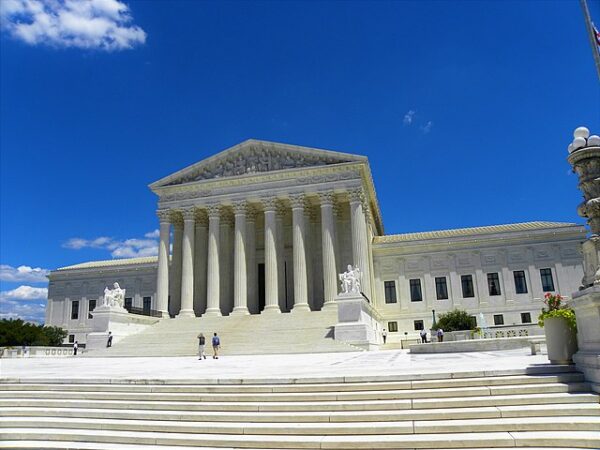

The Supreme Court reportedly delivered a significant victory to President Donald Trump and Texas Republicans on Thursday, granting the state permission to use its newly drawn congressional district map in next year’s midterm elections.
The map—crafted to expand GOP strength and add as many as five Republican seats—will now move forward after the Court halted a lower-court ruling that attempted to block it.
In a major rebuke to Democrat-led legal challenges, the Court’s conservative majority approved an emergency request filed by Texas Gov. Greg Abbott.
The lower court had claimed Texas lawmakers unlawfully considered race while drawing the new lines, despite doing so at the direction of the Trump administration’s broader political strategy. But the Supreme Court sharply disagreed, saying Texas is “likely to succeed” in defending the map and emphasizing that the lower court failed to give proper weight to the “presumption of legislative good faith.”
Texas Attorney General Ken Paxton celebrated the ruling as a triumph against what he called partisan legal warfare. “This map reflects the political climate of our state and is a massive win for Texas and every conservative who is tired of watching the left try to upend the political system with bogus lawsuits,” Paxton said.
Trump’s Justice Department had also supported Texas, arguing that states have full authority to redraw congressional lines for partisan purposes. Attorney General Pam Bondi echoed that sentiment after the decision, saying, “Federal courts have no right to interfere with a State’s decision to redraw legislative maps for partisan reasons.”
Democrats, however, reacted with fury. House Minority Leader Hakeem Jeffries claimed the justices had “shredded [the Court’s] credibility by rubber-stamping a racially gerrymandered map.” Still, he acknowledged that Democrats are already moving to counter the GOP advantage by redrawing California’s congressional map—and potentially others—anticipating the political implications of the Texas decision.
The Supreme Court’s unsigned order, appearing to split 6–3 along ideological lines, stressed that the lower court inserted itself into Texas election procedures far too close to the 2024 cycle. The Court indicated that intervening with nearly a year until the vote still risked disrupting the state’s election administration.
Justice Elena Kagan, writing in dissent, accused the majority of disrespecting the district court’s work and ignoring findings that minority voters were shifted between districts based on race. But in a concurring opinion, Justice Samuel Alito pushed back, noting that challengers failed to provide an alternative map proving partisan gains could be achieved without considering race. Their inability to do so, Alito said, created “a strong inference” that the map reflected political—not racial—aims.

Opponents of the ruling, including groups like LULAC, the Texas NAACP, and two Democratic members of Congress, argued that Texas was motivated by race in eliminating so-called “coalition districts.” But Texas lawmakers countered that the Legislature simply did what legislatures do: politics.
The case highlights a broader redistricting push encouraged by Trump, who has urged Republican states to redraw maps outside the usual post-census cycle. And with the Supreme Court’s 2019 ruling permitting partisan gerrymandering, states like Texas now have greater freedom to fortify GOP power—within the limits of the Constitution and Voting Rights Act.
For now, Texas Republicans will head into the 2024 elections armed with a map designed to strengthen their majority, while Democrats brace for the political fallout.
[READ MORE: Hegseth’s Removal of Top Caribbean Commander Raises Fresh Questions About Military Leadership and Legal Clarity]