
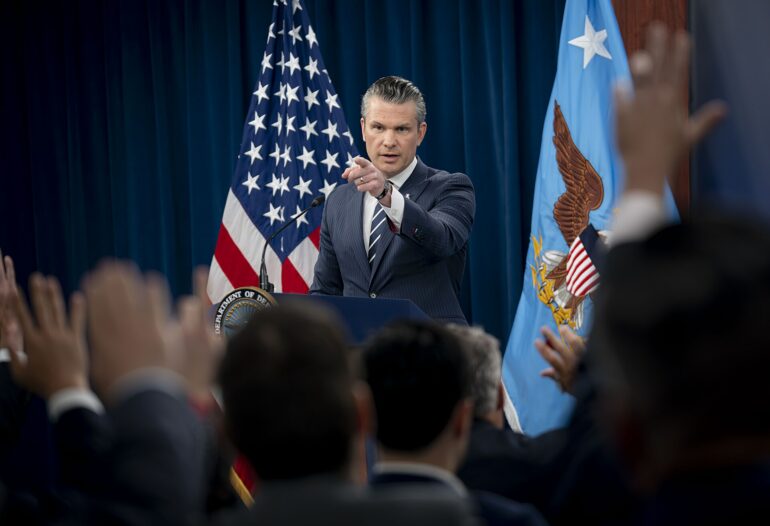

Defense Secretary Pete Hegseth reportedly stunned Washington in mid-October when he announced the sudden retirement of Adm. Alvin Holsey, the four-star officer overseeing U.S. military operations in the Caribbean.
What was framed publicly as a retirement was, according to Pentagon officials, actually a request for Holsey to step down—an extraordinary move that capped months of internal tension between the defense secretary and the commander responsible for carrying out the administration’s escalating campaign against drug trafficking.
The strain reportedly began just days after President Trump’s inauguration and deepened when Holsey raised early concerns about the legality of lethal military strikes on alleged drug boats in the Caribbean.
These operations, a major component of the administration’s approach to countering cartels, became a central point of friction and ultimately contributed to Hegseth’s decision to replace him. Not long after the disagreements intensified, Hegseth announced that Holsey would be retiring.
The decision sheds new light on the growing debate surrounding the legal foundation for the military’s expanding operations in the region.
While Hegseth has dismissed several high-ranking officers since taking over the Pentagon, removing a combatant commander in the middle of an active campaign remains highly unusual. Critics argue that the move raises questions about how dissenting views within the military are being handled.
Todd Robinson, who served as assistant secretary for international narcotics and law enforcement affairs until January, called Holsey’s removal “shocking,” noting its timing at the height of what defense officials have described as a central mission in the Western Hemisphere. A Pentagon spokesman declined to comment on the matter.
Holsey, a 60-year-old Navy helicopter pilot from rural Georgia and a veteran of counterdrug missions, initially appeared well-suited to execute Trump’s more aggressive strategy.
At his 2024 Senate confirmation hearing, he argued for increasing pressure on cartels, describing them as responsible for tens of thousands of American deaths. His résumé included command of a carrier strike group and leadership of an international naval task force protecting shipping in the Persian Gulf during Trump’s first term.
But tensions mounted quickly. Shortly after Holsey took command at Southern Command, he met Hegseth via secure video and received blunt marching orders: “You’re either on the team or you’re not,” Hegseth told him, stressing that orders should be executed swiftly and without hesitation.
After Trump publicly stated his desire to “reclaim” the Panama Canal, Hegseth directed Holsey to develop military options, later becoming frustrated with what he viewed as slow progress. According to former officials, Hegseth grew suspicious that Holsey may have been connected to subsequent media leaks about the planning efforts.
Although relations briefly improved during an April visit to Panama, conflict resurfaced when the military began lethal strikes on alleged drug boats in late summer.
Holsey questioned whether parts of the operation fell outside his authority, especially as elite units under separate chains of command became involved. By that point, Hegseth had already lost confidence in him.
Since September, the U.S. has dramatically expanded its presence in the region and conducted at least 21 strikes that killed more than 80 people. A classified Justice Department opinion argues these operations are lawful under Trump’s terrorist designation for cartels. Holsey, who has not publicly addressed his departure, will leave the military on December 12.
Tensions culminated in a Pentagon confrontation in early October, yet Hegseth publicly praised Holsey on Oct. 16, calling him an exemplary leader. Holsey’s own farewell message avoided the issue of the boat strikes but urged deployed forces to “sail strong, be bold, and strike.”
While in the region, Hegseth announced another attack that killed two people, underscoring the administration’s continued commitment to its campaign.
[READ MORE: Costco Sues Biden Administration Over Trump-Era Tariffs, Citing Supreme Court Doubts About Legality]