

President Donald Trump defended his administration’s efforts to identify government leakers on Friday, saying the Justice Department’s subpoenas involving New York Times reporters were aimed at uncovering the sources behind national security leaks rather than targeting journalists themselves.
The president’s comments came one day after the Department of Justice withdrew subpoenas seeking phone records and grand jury testimony from three New York Times reporters.
The subpoenas were withdrawn after U.S. District Judge Arun Subramanian sharply criticized the government’s handling of the case and indicated he was prepared to quash the subpoenas. During the proceedings, the judge questioned whether prosecutors had complied with the legal standards governing the subpoena of journalists.
According to the article, the subpoenas had been issued just two days after The New York Times published its initial report stating that security concerns had prompted Trump not to use a gifted Qatari aircraft for his July 8 trip departing from Turkey.
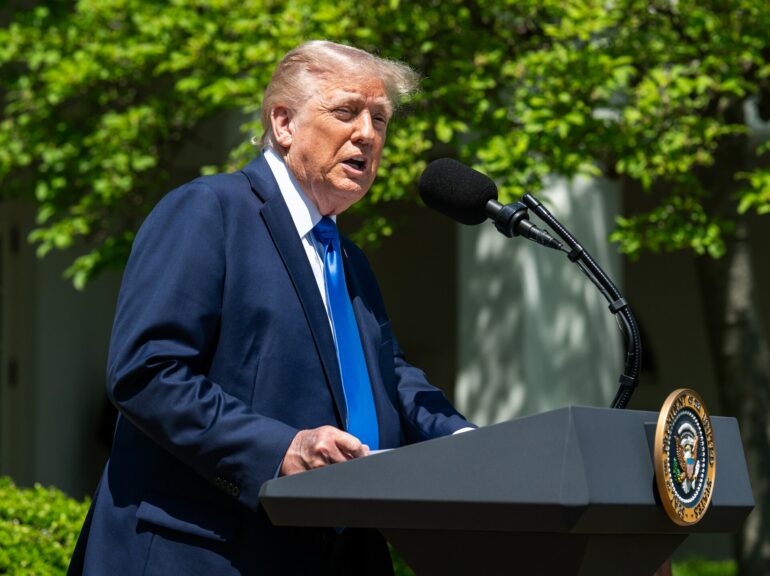
Speaking during an Oval Office press briefing on Friday, Trump emphasized that his administration’s focus was on identifying government officials responsible for leaking sensitive information rather than members of the press.
“We’re not after journalists. We’re after leakers,” Trump said.
The president characterized those responsible for unauthorized disclosures in harsh terms.
“We’re after people that are cowards, people that are unpatriotic, people that are treasonous, in many cases,” he said.
Trump argued that journalists can play a key role in identifying the individuals responsible for leaking sensitive information.
“And the way you find them is through the journalists,” he said.
Referring specifically to cases involving national security, Trump added, “If it’s something having to do with national security, you tell the journalist, ‘Who is it?’ and we have a long way to go with that case.”
The president was also asked whether he believed it was appropriate to subpoena family members of journalists in an effort to identify confidential sources, as had reportedly occurred in the case involving at least one Times reporter.
Trump responded that he was not prepared to draw a definitive line on what investigative methods were appropriate, while maintaining that his administration acts within the law.
“I don’t know what’s appropriate and what’s not. We do it legally,” Trump said.
He then pointed to the Obama administration, arguing that similar investigative tactics had been used during Barack Obama’s presidency.
“Barack Hussein Obama did it all the time. He went after journalists and nobody said anything about it,” Trump said.
According to Trump, investigators under Obama also sought to identify the sources behind unauthorized disclosures.
“They’d say, ‘Who was the leaker? Who was the leaker? And if you don’t give us the leaker, you’re going to jail.’ You know that,” Trump said.

The president argued that his administration has faced greater scrutiny than previous administrations over similar actions.
“But when, you know, Obama does it, it’s okay, but when I do it, it’s not,” Trump said.
Trump maintained that questioning journalists may be necessary in some national security investigations to identify government employees responsible for leaking classified or sensitive information.
“In many cases, that’s the only way you’re gonna find out who a leaker is, and it has to do with national security,” he said.
He continued by arguing that similar actions under Democratic administrations had not generated the same level of public criticism.
“It’s amazing. He did it many times, and nobody said anything about it, but when a Republican does it, when, in particular, Trump does it, everybody makes a big deal,” Trump said.
The president concluded by emphasizing that he believes national security leaks require aggressive investigation, particularly when the disclosures originate from within the White House or other sensitive government offices.
“I would say I really put it down to national security, not in all cases, but when you have somebody doing a national security leak, or a leak of great importance, and you have somebody inside the walls of, let’s say, the White House leaking, I think that’s a national security concern,” Trump said.
[READ MORE: Laura Ingraham Offers Rare Praise for AOC While Questioning Her Political Vision]