
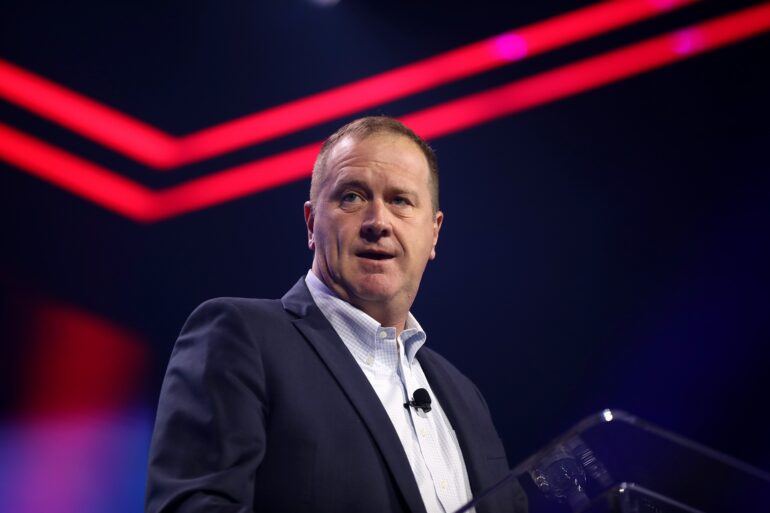

Sen. Eric Schmitt (R-MO) is reportedly touting what he calls a sweeping victory for free speech after a settlement was reached in the closely watched Missouri v. Biden case, a lawsuit he originally brought while serving as Missouri’s attorney general. The agreement, finalized through a consent decree, places new restrictions on how certain federal agencies can interact with social media platforms when it comes to constitutionally protected speech.
At the heart of the settlement is a prohibition on key federal entities—including the U.S. Surgeon General, the Centers for Disease Control and Prevention (CDC), and the Cybersecurity and Infrastructure Security Agency (CISA)—from pressuring social media companies to censor lawful speech. The agreement also prevents federal officials from interfering in how those companies make their own content moderation decisions.
Schmitt framed the outcome as a defining moment for First Amendment protections, particularly in an era where much of the public square has moved online.
“This is a massive win for the First Amendment and for every American who believes in free speech,” Schmitt said in a statement. He sharply criticized the Biden administration, accusing it of overreach and alleging that federal officials worked in coordination with major tech platforms to suppress certain viewpoints.
According to Schmitt, topics ranging from COVID-19 to Hunter Biden’s laptop and border policy became flashpoints where government officials sought to influence what Americans could see and share online. He argued that such actions effectively turned private companies into “speech police,” a dynamic the settlement now seeks to curtail.
The consent decree resolves the remaining claims in the case without further litigation, but its implications could be long-lasting. Under the terms, the federal government has agreed to a 10-year, court-enforceable injunction. That injunction bars the named agencies from threatening social media platforms with legal, regulatory, or economic consequences in an effort to induce the removal, suppression, or algorithmic downranking of protected speech.
Supporters of the settlement say it establishes the first clear, operational limits on how certain federal officials can engage with tech companies in this space. It reinforces the principle that First Amendment protections do not disappear simply because speech occurs on digital platforms or is labeled by the government as misinformation or disinformation.
At the same time, the agreement signals a broader effort to draw firmer boundaries between government authority and private sector decision-making in the rapidly evolving world of online communication. While social media companies retain the ability to moderate content, the settlement aims to ensure those decisions are not shaped by government coercion.
The case itself dates back to 2022, when Schmitt, then serving as Missouri’s attorney general, filed the lawsuit alleging what he described as a “vast censorship enterprise” involving federal officials and major tech firms. Since joining the Senate, he has continued to focus on the issue as a member of the Commerce Committee, frequently raising concerns about government influence over online speech.
Schmitt has also pursued legislative solutions alongside the legal battle. He introduced the COLLUDE Act, which would remove Section 230 protections from companies that censor speech at the direction of government actors. Additionally, he has proposed the Censorship Accountability Act, designed to allow private citizens to sue federal officials if they believe their speech has been improperly restricted.
While the legal fight has now reached a settlement, the broader debate over free speech, government authority, and the role of Big Tech is far from over. Still, for Schmitt and his allies, the agreement represents a clear line drawn—one they argue ensures that even in a contentious and fast-moving digital landscape, the government cannot simply silence viewpoints it disagrees with.
[READ MORE: Trump Credits Hegseth as Early Voice for Iran War While Signaling Openness to Talks]