
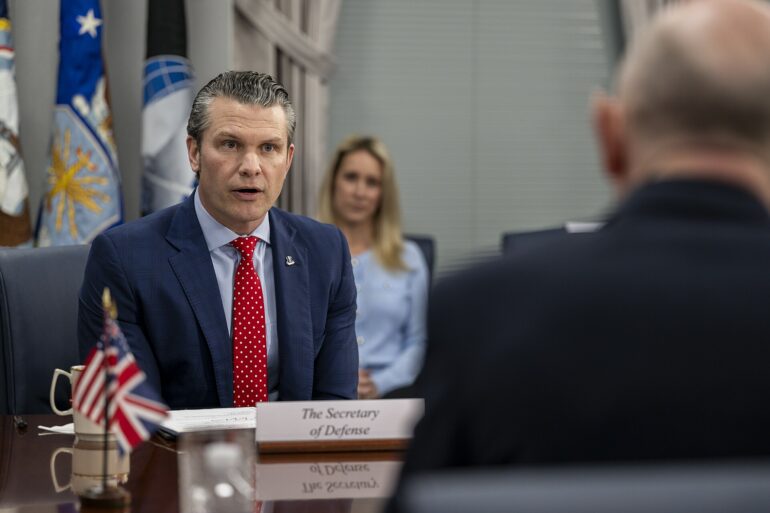

President Donald Trump said Monday that Defense Secretary Pete Hegseth was “the first” member of his administration to advocate for military action against Iran, a comment that could be read as either a show of confidence or a notable signal as tensions continue to evolve in the Middle East.
Speaking at a crime task force roundtable in Memphis, the president reflected on internal discussions that took place as the administration weighed its response to Iran. Trump described consulting with top officials before the United States, alongside Israel, began a series of strikes on Feb. 28.
“I called a lot of our great people,” Trump said, framing the deliberations as part of a broader effort to address what he described as a long-standing threat. He pointed to Iran’s history and its alleged proximity to obtaining a nuclear weapon as central concerns driving the decision-making process.
With Hegseth present, Trump singled him out as the earliest and most direct advocate for action. According to the president, the defense secretary urged a forceful response, arguing that Iran could not be allowed to develop a nuclear weapon. The remark placed Hegseth at the forefront of the administration’s push toward war, even as the broader strategy has continued to shift in the weeks since.
The conflict has come at a steep cost. Since fighting began, 13 American service members have been killed, along with more than 1,300 Iranians. While the administration has offered multiple justifications for the strikes, it has increasingly emphasized the nuclear threat posed by Iran — a rationale that stands in some tension with Trump’s earlier assertion that Iranian nuclear facilities had been “totally obliterated” in prior joint U.S.-Israeli operations.
Meanwhile, the consequences of the conflict have extended beyond the battlefield. Iran responded to the attacks by closing the Strait of Hormuz, a critical passage for global oil shipments. The move has disrupted supply and driven prices higher, underscoring the far-reaching economic stakes tied to the confrontation.
Trump has taken a firm stance on reopening the strait, warning that failure to do so would result in further escalation, including potential strikes on Iran’s power infrastructure. At the same time, the president signaled a possible shift in tone Monday, announcing a pause on certain strikes and suggesting that diplomatic channels may be opening.
“We are now having really good discussions,” Trump said, indicating that talks had begun recently. He added that there was a “very good chance” of progress, claiming that Iran had agreed it would not pursue a nuclear weapon. Iranian officials, however, denied that any negotiations were underway, casting uncertainty over the prospects for a diplomatic breakthrough.
The administration has also leaned on its alliance with Israel, which Trump described as “a great partner in this fight.” That partnership has been central to the military campaign, though it also highlights the broader regional stakes and the risk of continued escalation.
As the situation develops, Trump’s remarks about Hegseth offer a revealing glimpse into how the decision to go to war took shape inside the administration. At the same time, the president’s cautious optimism about talks suggests an awareness that prolonged conflict carries significant costs — both in lives and in economic disruption — even as officials continue to defend the initial decision to act.
[READ MORE: Shannon Bream’s Latest Bestseller Highlights Faith, Resilience in Uncertain Times]