
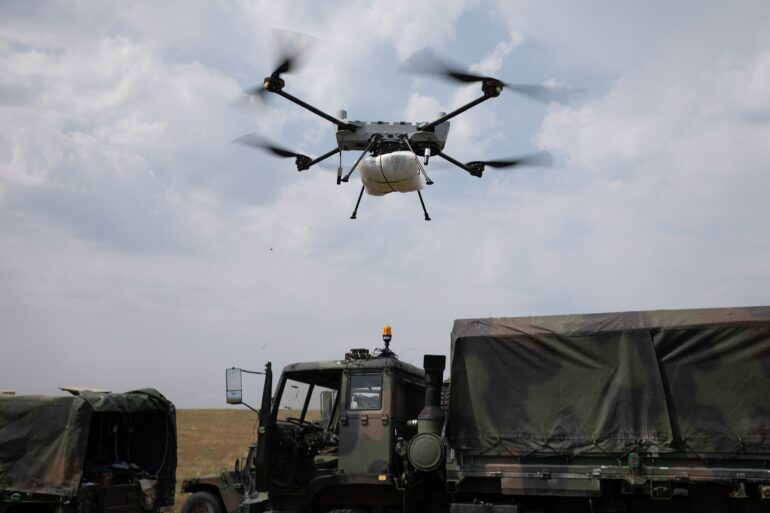

Unidentified drones spotted over a sensitive U.S. military installation in Washington, D.C., have triggered fresh concerns about security at the highest levels of government, underscoring the uneasy reality facing officials amid an increasingly volatile global environment.
According to a report Wednesday night, several drones of unknown origin were seen flying over Fort Lesley J. McNair within the past 10 days. The base, located less than four miles from the White House, is currently housing Defense Secretary Pete Hegseth and Secretary of State Marco Rubio—two of the administration’s most prominent figures during a period of heightened international conflict.
The sightings reportedly prompted serious internal discussions, including a White House-level meeting to determine how to respond. Among the options considered was relocating both Hegseth and Rubio to another, more secure location. While that step was ultimately not taken, the fact it was under consideration highlights the level of concern within the administration.
Officials have released limited information about the incident, citing the sensitivity of the situation. Pentagon spokesman Sean Parnell declined to comment on the movements or security posture of the defense secretary, stating that such reporting is “grossly irresponsible” given the potential risks involved.
Still, the episode raises pressing questions. The presence of unidentified drones over a military base so close to the heart of the federal government is not just unusual—it is deeply unsettling. In a time when U.S. forces are engaged in an ongoing war with Iran, even small breaches of airspace can carry outsized implications.
The drones’ origin and intent remain unclear, and no further details have been made public about their capabilities or whether they posed an immediate threat. But the uncertainty itself is enough to fuel concern, particularly as modern conflicts increasingly blur the line between conventional warfare and asymmetric tactics.
The situation also comes as multiple senior officials have already been relocated to military installations in recent months for security reasons. Attorney General Pam Bondi and senior adviser Stephen Miller have both been moved, while former Homeland Security Secretary Kristi Noem was transferred to Joint Base Anacostia-Bolling during the summer “for her own safety.”
Taken together, these moves suggest a broader shift in how the administration is approaching the safety of its top officials. While such precautions may be prudent, they also reflect a sobering reality: the risks associated with global conflict are no longer confined to distant battlefields.
At the same time, the lack of transparency surrounding incidents like the drone sightings can leave the public with more questions than answers. Americans expect their government to remain vigilant, but they also expect clarity when potential threats emerge so close to home.
There is little doubt that protecting national leadership is a top priority, and few would argue against taking precautions in uncertain times. Yet the appearance of unidentified drones over a secure military base serves as a stark reminder that even the most powerful nation in the world is not immune to the ripple effects of conflict.
As officials continue to assess the situation, one thing is clear: in an era defined by evolving threats and ongoing military engagements, maintaining security is becoming more complex—and more costly—by the day.
[READ MORE: MS NOW Shakes Up Lineup After NBC Split as Network Charts a New Course]