
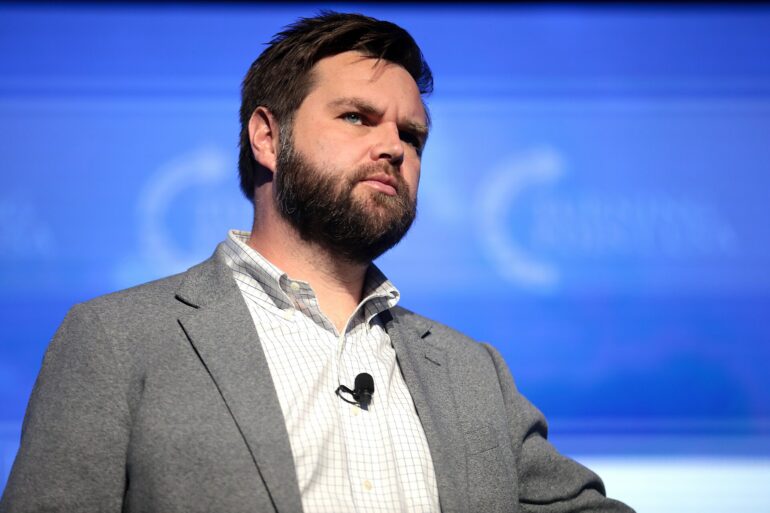

Vice President JD Vance declined on Friday to reveal what advice he offered President Donald Trump ahead of U.S. strikes on Iran, telling reporters that the conversations inside the White House Situation Room remain classified.
Speaking to reporters in Rocky Mount, North Carolina, Vance made it clear that discussions among the president and his top advisers were not meant for public disclosure. He said he would not repeat what he told Trump during those high-level deliberations.
“I hate to disappoint you, but I’m not going to show up here and in front of God and everybody else [and] tell you exactly what I said in that classified room,” Vance said.
The vice president joked that part of the reason for his silence was practical.
“Partially because I don’t want to go to prison,” he said, before adding that confidentiality is also essential for effective leadership.
Vance argued that presidents must be able to receive candid advice from their advisers without worrying that internal discussions will quickly become headlines.
“I think it’s important for the president of the United States to be able to talk to those advisers without those advisers running their mouth to the American media,” he said.
His remarks come amid reports suggesting there may have been differences in outlook between Vance and Trump over how aggressively the United States should move against Iran. Vance has previously expressed skepticism about long-term American involvement in foreign conflicts, a stance that has resonated with many conservatives who are wary of extended overseas engagements.
Despite those reports, Trump earlier this week sought to downplay any suggestion of serious disagreement within his administration.
Speaking Monday, the president acknowledged that Vance may have initially approached the situation with a slightly different philosophical perspective. Still, Trump emphasized that the two ultimately found common ground on the decision to act.
“He was, I would say, philosophically a little bit different than me,” Trump said. “I think he was maybe less enthusiastic about going, but he was quite enthusiastic.”
Trump explained that he believed the strikes were necessary under the circumstances, arguing that failing to act could have left the United States vulnerable.
“But I felt it was something we had to do,” the president said. “I didn’t feel we had a choice. If we didn’t do it, they would have done it to us.”
Trump also pointed to negotiations that had been underway involving several key figures in his administration, including Steve Witkoff, Jared Kushner, Secretary of State Marco Rubio and Defense Secretary Pete Hegseth. According to Trump, the situation developed in a way that convinced him decisive action was required.
“I felt that based on the negotiations that were being had with Steve Witkoff and Jared Kushner and Marco [Rubio] and Pete [Hegseth] and everybody that was involved, I felt that they were looking to tap us along,” he said.

Defense Secretary Pete Hegseth addressed the reports of tension on Friday and firmly rejected the idea that the administration’s leadership was divided. Speaking during a Pentagon press briefing, Hegseth described Vance as an essential member of the president’s national security team.
“He’s an incredible member, leader of this team as well, alongside the president and secretary of State,” Hegseth said.
The defense secretary praised the administration’s internal process, emphasizing that the president receives input from a range of advisers before making final decisions.
“I can’t say enough great stuff about this team, how it works together, how it provides options to the president,” Hegseth added.
“And the vice president, every single day is a key voice in that.”
While the details of those deliberations remain secret, the exchange highlights the ongoing tension many Americans feel when the country faces another potential foreign conflict—balancing the need for decisive action with the caution that comes from hard lessons learned in past wars.
[READ MORE: Hegseth Slams CNN Coverage of Iran War]