
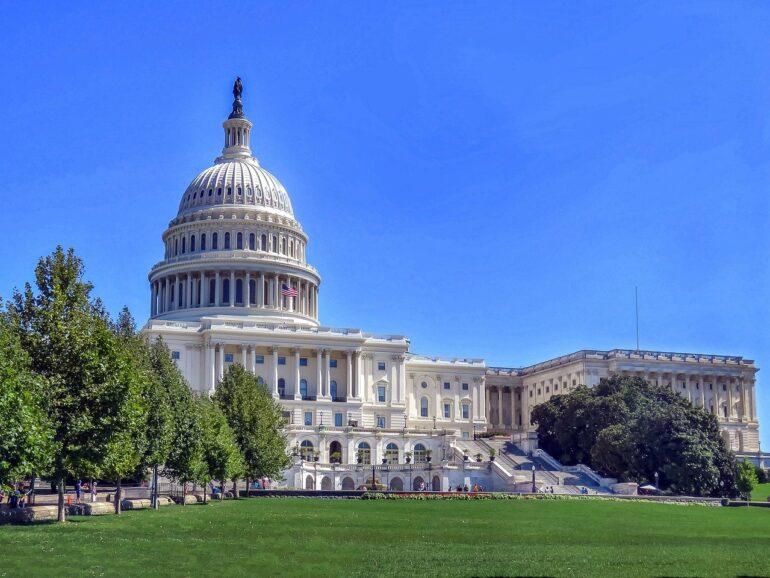

A dramatic showdown unfolded in the Republican-controlled House of Representatives Tuesday evening as lawmakers failed to advance a key procedural rule designed to shield President Donald Trump’s tariffs from congressional challenges for most of 2026.
In a narrow 214-217 vote, the House fell short of the simple majority needed to adopt the rule. The measure would have prevented any lawmaker from forcing a vote to terminate President Trump’s tariffs on Canada, Mexico and Brazil until early August. With Republicans holding a slim 218-214 majority, House Speaker Mike Johnson could afford to lose just one defection if all members were present and voting. Instead, three Republicans broke ranks.
Reps. Thomas Massie of Kentucky, Kevin Kiley of California and Don Bacon of Nebraska joined every House Democrat in opposing the rule. Two Republicans did not vote, including North Carolina Rep. Greg Murphy, who has been absent all week after undergoing surgery in December for a benign tumor in his skull.
The failed vote came after GOP leaders delayed the proceeding for seven hours, originally scheduling it for earlier in the afternoon as they worked to shore up support. Despite the effort, the rule did not pass.
The proposed measure would have temporarily blocked lawmakers from triggering votes to cancel the tariffs, which are tied to presidential emergency powers. The House is expected to be out of session in August and again in October as members campaign ahead of November’s midterm elections, effectively limiting opportunities for opponents to force action during that time.
Massie, a vocal critic of tariffs who is facing a Trump-backed primary challenge, immediately voted against the rule. He later took to social media, arguing that the law requires Congress to allow a vote on presidential emergencies within 15 days of their declaration.
“The law requires Congress to permit a vote on Presidential emergencies within 15 days of being declared,” Massie wrote. “Today the Speaker is trying to pass a resolution that literally says a day is not a day, just to avoid voting on the emergencies that underpin the tariffs. Smoke & mirrors!”
Bacon also cited constitutional concerns, telling reporters as he left the Capitol, “I have to answer to Article I,” referencing Congress’s authority over tariffs.
Frustration has been building among some rank-and-file Republicans who argue that leadership has repeatedly blocked efforts to force votes on resolutions aimed at eliminating the president’s tariffs. In March 2025, the House narrowly approved a similar procedural maneuver, 216-214, to prevent lawmakers from bringing up legislation to overturn the tariffs. That measure expired Jan. 31.
With the procedural shield now lapsed, Democratic Rep. Gregory Meeks of New York has pledged to force a vote on revoking Trump’s Canada tariffs unless GOP leadership intervenes again. An earlier version of such a resolution cleared the Senate in October with support from four Republicans, suggesting it could pass the upper chamber once more. However, any measure reaching President Trump’s desk would likely face an immediate veto.

Speaker Johnson defended the effort to extend protections, pointing to a pending Supreme Court case involving the president’s tariff authority.
“The rationale for extending this a bit longer to July is to allow the Supreme Court to rule on the pending case,” Johnson said. “That process has been playing out. I think it’s logical to allow that to continue.”
Johnson also praised the president’s trade agenda, calling it a “great benefit to the country.”
Public opinion remains divided. A Marist survey released Feb. 5 found that 56% of Americans believe tariffs are harmful to the U.S. economy, underscoring the political stakes as the debate continues.
[READ MORE: New Hampshire Governor Vetoes GOP Bathroom Bill, Rekindling Intraparty Divide]