
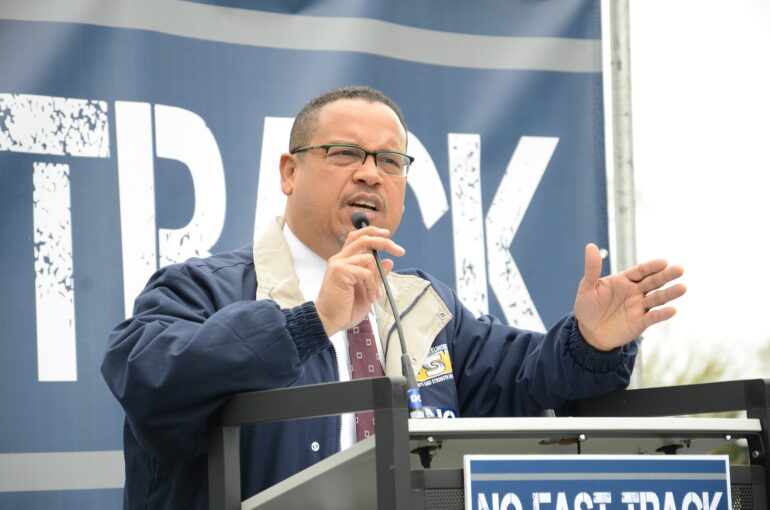

A disruptive scene unfolded Sunday at a church in St. Paul, Minnesota, when a group of left-wing activists, accompanied by former CNN host Don Lemon, interrupted a worship service and effectively forced it to end. The following day, Lemon hosted Minnesota Attorney General Keith Ellison on a podcast, where Ellison argued that the activists were within their rights to disrupt the religious gathering.
According to a report, dozens of protesters entered Cities Church as part of what activist leader Nekima Levy-Armstrong described as a “clandestine operation” designed to “disrupt business as usual.” Lemon embedded himself with the protest group as the demonstration unfolded. The protesters remained inside the church for roughly 30 minutes, creating enough disturbance that congregants were driven out and the service was brought to an early end.
During the podcast discussion, Lemon asked Ellison to respond to the church invasion. Ellison did not condemn the disruption. Instead, he framed it as a legitimate exercise of free expression, insisting that protest is foundational to the American experience. Ellison said the country itself “started in a protest” and argued that people have a right to raise their voices and make their case, even in settings others may consider inappropriate. He suggested that no institution or individual is immune from public expression and that such conflicts are simply part of living in a free society.
Ellison attempted to balance references to the First Amendment, mentioning both freedom of religion and freedom of expression, but ultimately suggested that religious institutions must accept such disruptions as a reality of modern America. He indicated that this was something people “gotta live with,” even when it occurs during a church service.
Notably absent from Ellison’s comments was any acknowledgment of the 1994 Freedom of Access to Clinic Entrances Act, commonly known as the FACE Act. The law makes it a federal offense to use force, threats, or physical obstruction to intentionally interfere with individuals exercising their First Amendment right to religious freedom at places of worship. The statute explicitly states that those who intimidate or obstruct people lawfully practicing their faith in religious settings may be subject to prosecution.
Rather than addressing that law, Ellison shifted the focus to criticism of the current administration. He claimed that officials are “real tender” when issues affect their own interests but are less concerned when those same principles do not work in their favor. He dismissed concerns about the church disruption by suggesting that outrage over the incident was politically motivated.
Ellison went further, alleging that authorities arrest people in clinics, schools, and churches whenever they choose, and that so-called sacred or sensitive spaces are only respected when it benefits those in power. According to Ellison, protections for such places are applied inconsistently and selectively.
In a surprising turn, Ellison then pivoted away from the church incident entirely, referencing President Donald Trump’s criticism of Jimmy Kimmel over remarks about the death of Charlie Kirk. Ellison concluded the tangent with an unrelated jab at Trump, saying that “the mad king won’t let you say jokes about him.”
The episode underscored a sharp divide over religious liberty, free speech, and the boundaries of protest. While congregants saw their worship service disrupted and ended, Ellison’s defense made clear that, in his view, political activism can override concerns about the sanctity of religious spaces.
[READ MORE: Lahren Says Omar Proves the Case for Strong Borders After ICE Rant]