
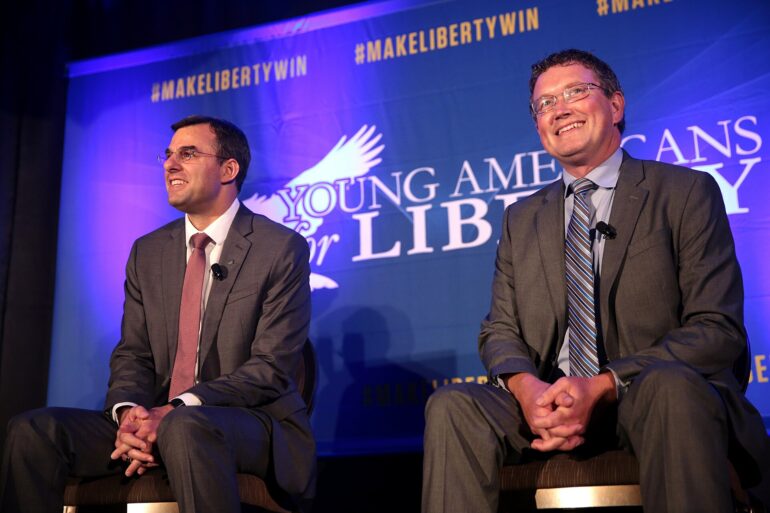

Rep. Thomas Massie on Friday sharply criticized President Donald Trump’s warning that the United States could intervene as Iran cracks down on anti-government protests, arguing the rhetoric is driven less by concern for free speech and more by oil and regional interests.
Trump vowed in a Truth Social post that the United States would “rescue” Iranian protesters if the regime takes violent action against them as demonstrations over Iran’s deteriorating economy spread. The president also warned that the U.S. was “locked and loaded and ready to go” should Iran’s government kill additional protesters. The statement immediately drew an angry response from Tehran, which threatened U.S. troops stationed in the region.
Massie, a libertarian-leaning Republican who has frequently clashed with Trump on foreign policy and executive power, responded on X with a pointed, numbered list of objections. He began by arguing that the United States should focus on domestic problems rather than inserting itself into another country’s internal affairs.
“We have problems at home and shouldn’t be wasting military resources on another country’s internal affairs,” Massie wrote. He also emphasized that any military strikes against Iran would require congressional authorization, a recurring argument he has made when opposing unilateral uses of force by presidents of both parties.
Massie went further, questioning the motives behind Trump’s warning. “This threat isn’t about freedom of speech in Iran; it’s about the dollar, oil, and Israel,” the Kentucky Republican added. His remarks underscored a long-running debate within the GOP between America First restraint and more aggressive foreign policy postures in the Middle East.
Iran remains a major player in global energy markets. According to the U.S. Energy Information Administration, Iran ranked as the fourth-largest crude oil producer among OPEC nations in 2023. The protests now unfolding in the country were sparked over the weekend as economic conditions worsened, fueling broader anti-government anger.
Human rights groups and Iranian media outlets have reported a violent response from authorities. The Hengaw Organization for Human Rights said Thursday that at least 29 demonstrators have been detained amid the unrest. That same day, at least three protesters were killed and 17 others wounded during an attack on a police station in Iran’s western Lorestan province, according to the semiofficial Far News Agency.
Trump’s warning to Iran followed his meeting earlier this week with Israeli Prime Minister Benjamin Netanyahu at Trump’s Mar-a-Lago resort in Florida. After that meeting, the president cautioned Iran against expanding its ballistic missile program or conducting additional tests, saying that if such actions were confirmed, “there will be consequences.” Trump has also publicly backed an Israeli strike on Iran should Tehran further expand its nuclear program.

The administration’s posture echoes past actions. Last June, the Trump administration authorized strikes on three Iranian nuclear sites without congressional approval. Massie opposed that operation at the time, telling CBS that Iran posed “no imminent threat,” and warning against bypassing Congress on matters of war.
Massie’s skepticism has extended beyond Iran. He was one of only two House Republicans, along with Rep. Don Bacon of Nebraska, to support a Democratic resolution last month aimed at ending hostilities with Venezuela. Several lawmakers have argued that the administration’s aggressive moves in the Caribbean, like those in the Middle East, are closely tied to oil interests.
The dispute highlights ongoing divisions within the Republican Party as Trump signals a willingness to escalate rhetoric abroad, while figures like Massie continue to press for restraint, congressional authority, and a narrower definition of America First foreign policy.
[READ MORE: GOP-Led Congress Sets Records in 2025, Highlighting Divisions and Power Struggles]